booth

About booth

This author has not yet filled in any details.
So far booth has created 2363 blog entries.

Concept to Canvas: Six Contemporary Artists

October 25, 2025 – March 15, 2026
Member opening Saturday, November 8, 2025

Artists: Jane Hunt, Michele Usibelli, Lori Putnam, Brent Cotton, Jay Moore & Randal Dutra

This select group of artists will create and share their process when working on a painting. Some work en plein air while others follow a different process when selecting a subject and following through to the final painting. From choosing a subject, making a sketch, painting a small color study to the finished work of art, visitors will learn the steps that go into creating the finished painting.


The Evolution of the Oval Office

The Oval Office is renowned for being the central place of power for the President of the United States, a space at once familiar and intimidating. Familiar due to its ubiquity in movies, photos, and speeches. Intimidating as the physical representation of the most powerful country on earth.

But the Oval Office also begs questions.  Why is it oval?  Who designed it? How big is it?  What famous furniture and artwork does it have?

Origins

Our first president, George Washington, had firm control over the design of the White House, selecting Irish architect James Hoban and working closely with him on the style and type of rooms he wanted.

Hoban learned that Washington had made architectural changes to his residences in New York and Philadelphia, creating large bow windows where he could stand for his levees to receive guests.  Washington requested oval shaped rooms in the new White House as well. Hoban created the first floor Blue Room and second floor Yellow Room in the same oval shape to accommodate Washington’s requests.

The Presidential Office

That was fine for entertaining, but the president had to work, too. From its first occupant, John Adams (1797-1801) all the way to Theodore Roosevelt (1901-1909), the presidents worked on the second floor in rooms near their own personal family spaces.  It wasn’t until Roosevelt’s wife Edith strongly urged her husband to create office space elsewhere that steps toward the modern Oval Office occurred.   Roosevelt knocked down ancient glass conservatories and built the West Wing in 1902.   He used a rectangular office in the center of the new building.

Roosevelt’s successor, William H. Taft (1909-1913), built the first Oval Office in 1909. Architect Nathan C. Wyeth recommended its shape and moved it to the south façade, positioning it more centrally in the workflow.  Twenty years later the Oval Office suffered major damage in a fire on Christmas Eve when Herbert Hoover (1929-1933) was president.


The Modern Oval Office

1934 marked the renovation that brought us the Oval Office we recognize today. Franklin D. Roosevelt (1933-1945) decided to make significant changes to the office, in part due to his use of a wheelchair. He excavated a full basement for offices under the adjacent lawn and built a new cabinet room and Oval Office. He added inset bookcases, doors topped with pediments, a ceiling medallion of the presidential seal, and indirect lighting.

All presidents are allowed to select new draperies, furniture, rug and artwork.  Some have also replaced the flooring itself. There have been four different floors in the Oval Office. The first was cork over softwood, followed by wood – grained linoleum selected by Lyndon Johnson (1963-1969). Ronald Reagan (1981-1989) installed an oak and walnut floor in cross parquet pattern, which George W. Bush replicated exactly in 2005.

The Resolute Desk

The Resolute Desk was a gift from Queen Victoria to President Rutherford Hayes (1877-1881). The desk was constructed from oak timbers of the British ship HMS Resolute and weighs 1,300 pounds.  It was delivered to the White House in 1880.

HMS Resolute explored the Arctic in 1855. It’s crew abandoned the ship when it froze in ice.  The Resolute drifted over 1,000 miles and was recovered by an American whaler. The US Congress authorized funds to repair the ship and return it to England. Once it was decommissioned in 1879, Queen Victoria had three desks made from the timbers, one of which was sent to President Hayes in gratitude for saving the ship.

Most presidents since Hayes have used the Resolute Desk. A few used a desk of their own that they preferred. John F. Kennedy’s young children famously used the privacy door of the Resolute Desk for play, having their photo taken while their dad worked. JFK also added a two-inch plinth to raise the height of the desk to make it more comfortable.

Artwork

Presidents are fond of having portraits of George Washington (1789-1797), the Founding Father, in the Oval Office. Jimmy Carter acquired a Charles Willson Peale portrait of Washington in 1977 and had it placed over the mantle.  Also frequently displayed have been portraits of presidents Jefferson, Jackson, and Lincoln, as well as founders Hamilton and Franklin.

Presidents also like to have busts of famous presidents and American leaders displayed in the Oval Office.  Eight presidents have displayed Frederic Remington’s The Bronco Buster.

You may have noticed from photos the ivy on the mantle of the Oval Office. This tradition began with John F. Kennedy who received the ivy plant as a gift from the Irish Ambassador.  All subsequent presidents have used descendants of that original plant to demonstrate continuity.

At 816 square feet, the Oval Office exudes power and functions as an ongoing site for all things presidential.  Most of the recently built presidential museums and libraries have a full-sized replica of the Oval Office that you can visit and even have your picture taken seated at a replica of the Resolute Desk.

Interested in learning more about the presidents? Visit the Carolyn & James Millar Presidential Gallery on the upper level of the Booth Western Art Museum. The gallery features original letters and photographs of every U.S. president. Learn more at www.boothmuseum.org.
2026-02-16T11:37:32-05:00Booth Blog|

Life After the Presidency

What happens to U.S. presidents after they serve in office?  Let’s take a closer look at this rarified atmosphere – ‘the most exclusive club in the world’ – one that has shown to be as varied as the 45 men who have been members.

Faced with the immense stress of being president, most former presidents want peace, tranquility, and little more.  Not counting the 8 Presidents who died in office, most retired to their home states to write their memoirs and stay out of the spotlight.

However, a few of our ex-Presidents tried to jump right back into the oval office. Some have been elected to Congress or served on the Supreme Court.  Some have pursued humanitarian causes, while some suffered personal tragedy and poverty.

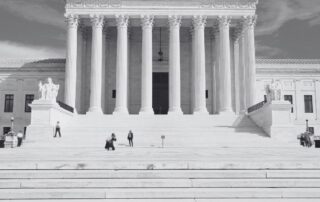
Uniquely, William Howard Taft became Chief Justice of the Supreme Court in 1921, serving until his death in 1931. He arguably accomplished more in his 9 years as Chief Justice than his four years as President, (an office his ambitious wife Nellie desired but he never did himself).  It was Taft who persuaded Congress to fund the construction of the recognizable Supreme Court building in Washington, finally moving The Court out of the basement of the Capitol.

Millard Fillmore’s wife died only three weeks after he left office, and his daughter died 15 months later. Despite such personal tragedy, he unsuccessfully ran for President again for the Know Nothing party, remarried a wealthy widow and became a philanthropist.

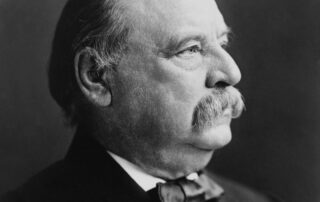
And then we come to Grover Cleveland, the only President elected to two non-consecutive terms. Defeated as an incumbent in 1888, his wife Frances said to the White House staff “keep everything in good order until we move back here in 4 years.”  And so, it was.  In 1892, Cleveland defeated incumbent Benjamin Harrison, reclaiming the levers of power.

John Quincy Adams ran for Congress after he left office and served 12 years, staunchly advocating for abolition of slavery. Known as Old Man Eloquent, he suffered a massive stroke at his desk on the floor of Congress and died in days.  Andrew Johnson, our impeached 17th President, was briefly Senator from Tennessee, serving 6 months before his death. And the 10th President, John Tyler, a life-long contrarian, was elected to the Congress of the Confederacy in 1861.

Prior to 1958, ex-Presidents received no pension, forcing them to fend for themselves to pay the bills.  This situation led to financial problems for several. Sadly, James Monroe died in poverty, partly due to the large, unreimbursed personal costs of serving our country for decades.  Thomas Jefferson was ‘land rich and cash poor’, so he was forced to sell his 6,400-volume book collection to the Library of Congress for $23,950 to generate some cash.

U.S. Grant was nearly bankrupt and diagnosed with cancer. He worried about how his family would survive without financial support.  Mark Twain, in his role as a publishing entrepreneur, approached the ex-president and offered to publish his memoirs for a handsome fee. Grant wrote a highly cogent, successful book, finishing it just days before his death from throat cancer.

In fear of his past coming to light after his death, in 1886 Chester Arthur ordered his staff to burn all his papers just before he died of kidney disease 1.5 years after leaving office. This is one reason we know so little about him, and the justifiable suspicion is that some of his notorious pre-presidency activities went up in flames.

Living here in Georgia, we’ve seen up close the lengthiest post presidency in history:  Jimmy Carter’s 43 years out of office is roughly three times the average. Mr. Carter created the Carter Center to address humanitarian causes, supervise democratic elections around the world, and build houses for Habitat for Humanity.  He won the Nobel Peace Prize in 2002, over two decades after leaving office. And he’s not done yet!

In modern days, most ex-Presidents are busy raising money for their libraries, giving speeches for a fee, and writing their memoirs for multi-million-dollar publishing deals. Who could blame them when the retirement benefit for former Presidents was only recently raised from $96,000 per year to $219,200?

However, it’s not just about the money. Several of the most recent members of the ‘most exclusive club in the world’ such as George H.W. Bush and Bill Clinton, have joined forces to assist in earthquake and hurricane relief efforts around the world, raising money and awareness as few others could.

Donald Trump has plunged back into national politics, earning the Republican nomination in 2024 in his effort to join Grover Cleveland as the non-consecutive presidents.

Interested in learning more about the presidents? Visit the Carolyn & James Millar Presidential Gallery on the upper level of the Booth Western Art Museum. The gallery features original letters and photographs of every U.S. president. Learn more at www.boothmuseum.org.

2026-02-16T11:27:20-05:00Booth Blog|

Georgia Natural Wonders: A Journey from Marshland to Mountains

January 6 – March 1, 2026
Art For Lunch: January 7, 2026

Artist Ann Litrel brings the spirit of Georgia’s wild landscapes to life in this solo exhibit of paintings from her new book published by UGA Press, “35 Natural Wonders in Georgia to See Before You Die”, written with co-author Charles Seabrook, longtime Atlanta Journal-Constitution science writer. The exhibition invites visitors on a visual journey through Georgia’s most iconic landscapes—from mountain peaks and river gorges to hidden barrier island marshes. The paintings are on display in the Borderlands Gallery.


Presidents and Supreme Court Nominations

Imagine Thomas Jefferson, John Adams, and James Madison having a drink and relishing the concept of checks and balances they’d just enshrined in our founding Constitution.

“Just wait until they need a new Supreme Court Justice. They’ll have to engage all three branches of government to accomplish it. Won’t that be glorious?”

Since 1789 that “glorious” experience has been accomplished 164 times. The President (Executive Branch) makes a nomination to the Senate (Legislative Branch), which provides “advice and consent” for the Supreme Court (Judicial Branch).

The Founding Fathers also imagined this process to be relatively pure and free of political shenanigans. In that, they suffered from naivete. Right off the bat, George Washington, who had the most justices confirmed among all the presidents at 10, had one of his nominees rejected by the Senate.   James Madison, the 4th President, had one nominee rejected. Over time we’ve seen 12 rejections in all, the most recent being Ronald Reagan’s nominee Robert Bork, in 1987. George W. Bush withdrew two nominations during his two terms. Merrick Garland was nominated by Barack Obama, but no action was taken.

The make-up of the Supreme Court, as realized by the number of justices, also evolved over time and was subject to political pressures.  Our 17th President, Andrew Johnson, was so reviled that the Congress passed a law in 1866 to reduce the number of justices from 10 to 8, to prevent Johnson from nominating any replacements. After Johnson survived impeachment (by one vote) and left office in 1869, Congress passed another law to cancel the 1866 law and settle the number of justices at 9, where it’s been ever since.

All was quiet on that front until 1937. Franklin D. Roosevelt, who was 9 for 9 in getting his nominees to the court confirmed, got a firm slap from the Court over some of his New Deal laws. Roosevelt was furious and sought ways to work around the Court. He floated the idea of expanding the number of justices from 9 to 15, a move that became known as court packing.  His strategy never made it into law.

For decades, these nominations received scant attention, with 52% of them confirmed by voice vote alone. The last voice vote was for one of Lyndon Johnson’s nominees in 1965. The nature of our politics now demands a roll call vote where a Senator must cast their vote in public, thus open to accountability, criticism, and pressure.

The Senate Rules for confirmation have also been adjusted over the years. It used to require a 67% majority for confirmation. Later, it was lowered to 60%, and as of 2017, now requires only a simple majority.  Given the current polarized political environment, if the bar was 67%, it’s likely no justices would ever be confirmed, eventually breaking down our government’s judicial branch entirely.

Setting aside the political nature of these nominations, some interesting bits of trivia have accumulated over the years.

William Howard Taft is the only man who has served both as president and Supreme Court justice.  While Chief Justice Taft lobbied Congress to build the Court its own home across the street from the Capitol.  He resigned his position to retire, as many do, just prior to his death in 1930.

One other man might have accomplished Taft’s feat, had Charles Evans Hughes defeated Woodrow Wilson in 1916. Hughes resigned his seat on the Court to run for president. Later, Herbert Hoover nominated him to rejoin the Court and he did so in 1930.

Also of interest: John Marshall, our 4th Chief Justice, was nominated by John Adams. He was Thomas Jefferson’s cousin, although they were in fact political rivals.

In times of national crisis, the Chief Justice has occasionally played a significant role in resolving the issue with presumed integrity and without bias.  Earl Warren served as the head of the Warren Commission in the 1964 investigation into the assassination of John F. Kennedy.  In 1974, Warren Burger headed the Court during the Watergate crisis, supervising several milestone decisions that ultimately led to the resignation of Richard Nixon.

Lyndon Johnson nominated Thurgood Marshall as the first black on the Court in 1967. Ronald Reagan nominated Sandra Day O’Connor as the first female on the Court in 1983. Barack Obama nominated Sonia Sotomajor as the first Hispanic on the court in 2009. Joe Biden nominated Ketanji Brown Jackson as the first black female onto the Court in 2022.

In the 21st Century, given the high stakes involved, the process in the future likely will not be “glorious”.

Interested in learning more about the presidents? Visit the Carolyn & James Millar Presidential Gallery on the upper level of the Booth Western Art Museum. The gallery features original letters and photographs of every U.S. president. Learn more at www.boothmuseum.org.

2026-01-15T14:13:25-05:00Booth Blog|

The West in Focus: Women

Through January 18, 2026
Art For Lunch: October 1, 2025, 12:15 PM

The West in Focus: Women will showcase 30-40 photographs from the Booth’s permanent collection. This includes portraits by Dorothea Lange and Imogen Cunningham, California scenes by Cara Weston, and classic depictions of Western women by Barbara Van Cleve, among others. Featuring exceptional photography by both women and men, the exhibition celebrates women from diverse eras, backgrounds, and cultures.


Jay Dusard, Rose Mary Mack, Artist, Prescott Arizona, 1969, 7.5 x 9.5″, gelatin silver print, Booth Western Art Museum permanent collection, Cartersville, Georgia, ph2018.005.050

Danny Lyon: The Bikeriders

Through January 18, 2026
Member Opening: August 2, 2025, 4:00 – 7:00 PM

This exhibit will feature 50 photographs by Danny Lyon, a renowned 1960s documentary photographer and filmmaker who famously chronicled the activities of the Chicago Outlaws motorcycle club from 1963 to 1967. It features black-and-white photographs, text by Lyon and excerpts from transcribed interviews with his fellow club members. The images convey a sense of personal authenticity while offering a gritty and bittersweet portrayal of individuals living on the fringes of society. Some photos have a romantic quality, and all are honest, showcasing documentary photography at its best.


Danny Lyon, Route 12 – Wisconsin, 1966, 16 x 20” modern gelatin silver print, Copyright Danny Lyon / Magnum Photos,  www.instagram.com/dannylyonphotos, www.bleakbeauty.com, Courtesy of Etherton Gallery

Education, Intelligence, and Performance of the Presidents

When it comes to the presidency, which is better?  To have an educated president, or a smart president? Is there any historical pattern of education level or intellect that correlates with success in the office?

To answer these questions it’s helpful to look at the presidents over our entire 233-year-old republic, remembering that 18th century education looked very different than modern schooling. It’s also helpful to have access to scholarly works such as Dr. Dean Simonton’s 2006 work to impute an IQ score for all the presidents. Plus, in modern times, hundreds of historians, professors, and professional observers of the presidents are annually asked by C-SPAN to rank the president’s performance from top to bottom.

Looking into the details of these factors places us at the intersection of education, IQ, and ranking of presidential performance. For the record, all these factors exist through Barack Obama but not yet completely for his later successors.

Education

Our presidents have had a wide range of formal education experiences, ranging from ‘no formal education’ (George Washington and Andrew Johnson), to PhD level (Woodrow Wilson).  These big differences in formal education are best understood in the context of the times.  Colonial America had fewer choices for formal education, although John Adams, his son John Quincy, and James Madison all graduated from Harvard or Princeton. Most, but not all modern presidents have had access to significant formal educational opportunities.

In addition to these founding fathers, John F. Kennedy, Theodore and Franklin Roosevelt, Barack Obama, and George W. Bush also graduated from Harvard, while Bill Clinton, Gerald Ford, George H.W. Bush, and William Howard Taft all graduated from Yale. Some have gone overseas for parts of their education, such as Kennedy attending the London School of Economics and Clinton attending Oxford.

At the other end of the education scale, Harry Truman and Andrew Jackson had little education beyond high school.

Intelligence

Without getting too deeply into the methodology used by Dr. Simonton, it’s fair to say that assigning an IQ score to the founding fathers is hard to do. That said, no one disputes that John Quincy Adams was by far our smartest president, with an IQ over 168.  Not too far behind was Thomas Jefferson at 154, John F. Kennedy at 150, Bill Clinton at 149, and Jimmy Carter and Barack Obama at 145.  Given the American average IQ of 100, the lowest presidential IQ, US Grant at 120, is well above average. Indeed the average IQ for the presidents is 135, near the ‘genius’ mark of 140+.

Performance Rank

Which brings us to the question of how well presidents performed in office. Such rankings by C-SPAN’s esteemed historians can be biased and most certainly subject to change over the years. The 2021 rankings:

  1. Abraham Lincoln
  2. George Washington
  3. Franklin Roosevelt
  4. Theodore Roosevelt
  5. Dwight Eisenhower
  6. Harry Truman
  7. Thomas Jefferson
  8. John F. Kennedy
  9. Ronald Reagan
  10. Barack Obama

As noted, neither Washington, Lincoln, nor Truman had much formal education nor high IQs, yet they are at the very top in performance. They would be called outliers in any analysis.

Washington commanded the highest levels of respect from all corners of the country and his leadership in the Revolution and convocations organizing our founding laws and Constitution made him a legend in his own time.

Harry Truman left office in 1953 with very low approval ratings. Yet over time, historians have pushed him higher and higher in the rankings, mostly for his handling of communist aggressions and setting up long term structures within our government such as the CIA, NATO, Joint Chiefs of Staff, and National Security Council to manage security issues for our country.

More predictably, the two Roosevelts, John F. Kennedy, and Barack Obama had it all going for them:  formal education, high intelligence, and they used those skills to perform among the very best.

These ranking exercises and assignment of IQ scores do not easily consider leadership, creativity, character, and personality as critical but subjective factors in a president’s performance. Therefore, they can be debated again and again.

It’s fair to say that the American people are sometimes best served by presidents who are better educated and have higher intelligence levels.  However, we must also leave room for tremendous performers who excel as leaders and have personality traits that enable them to succeed whether they achieved high levels of education or not.

Interested in learning more about the presidents? Visit the Carolyn & James Millar Presidential Gallery on the upper level of the Booth Western Art Museum. The gallery features original letters and photographs of every U.S. president. Learn more at www.boothmuseum.org.
2025-12-31T10:13:13-05:00Booth Blog|

Art For Lunch: Mark Medley: The West in Focus: Indigenous People

April 1, 2026, 12:15 PM

This midday presentation, inspired by the current exhibition, The West in Focus: Indigenous People, is a look at the Indigenous people and artists represented in the Booth Museum’s permanent photography collection. Curator of Photography Mark Medley will present a range of works by both Native and non-Native photographers, from nineteenth-century pioneers including William Henry Jackson, Jennie Ross Cobb, and Edward S. Curtis to modern artists such as Zoë Marieh Urness, Kevin Garrett, and Douglas Miles. A particular highlight will be eight portraits of Native American survivors of the Battle of the Little Bighorn, made during a 1948 reunion by South Dakota photographer Bill Groethe.

Lunch will be available for $15.00 plus tax. Deadline to register for lunch is Noon, March 31. Go to boothmuseum.org to make your reservation for lunch or watch LIVE on Booth Museum’s Facebook page and YouTube channel. Attendees are encouraged to arrive early. Program included with admission. No outside food or beverages.


Go to Top