booth

About booth

This author has not yet filled in any details.
So far booth has created 2363 blog entries.

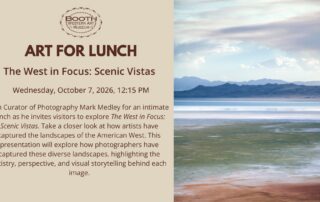
Art for Lunch: The West in Focus: Scenic Vistas

Art for Lunch: The West in Focus: Scenic Vistas
Wednesday, October 7, 2026
12:15 PM, Miller/Rhoden Ballroom

Join Booth Curator of Photography Mark Medley for an intimate lunch as he explores The West in Focus: Scenic Vistas, a photography exhibition celebrating the beauty, grandeur, and cultural significance of the American West. Featuring works from the Booth Museum’s permanent photography collection, the exhibition showcases iconic landscapes from across the region, including Yosemite’s Half Dome, Wyoming’s Teton Range, California’s Big Sur coastline, and Alaska’s Lake Chauekuktuli. Discover how photographers have captured the diverse landscapes of the West through artistry, perspective, and visual story telling.

Lunch will be available for $15.00 plus tax. Deadline to register for lunch is Noon, October 6. Go to boothmuseum.org to make your reservation for lunch. Attendees are encouraged to arrive early. Program included with admission. No outside food or beverages.

REGISTER HERE!

The Tafts: Almost a Dynasty

Written by Chris Binkert

William Howard Taft’s one term as President (1909-1913) was sandwiched between two of the 20th Century’s mega-star presidencies:  Theodore Roosevelt (1901-1909) and Woodrow Wilson (1913-1921).

His productive nine years as Chief Justice of the Supreme Court (1921 – 1930) places him in the unique position of being the only man to have served as both President and Chief Justice.

What you may not know is that the Taft Family was one of the earliest near dynasties in American politics.  Beginning in 1675 and now into their 350th year, the Tafts have served in office representing seven states, most prominently in Ohio and Rhode Island.  There have been two governors, three US Senators, two Secretaries of War (now Defense), a President of the United States and a Chief Justice of the United States.

Historically, Taft family soldiers fought in the Revolutionary War at Lexington Massachusetts, and George Washington, as President in 1789, stayed at Taft Tavern while on his inaugural trip to New England.

In William Howard’s case, his father, Alphonso Taft, was a founding member of the Republican Party, served as Secretary of War and later Attorney General under President Ulysses Grant, and later was Ambassador to Austria-Hungary and Ambassador to Russia under President Chester Arthur.

Born in Cincinnati in 1857, William Howard was bright and ambitious, being named Solicitor General of the United States (representing the USA at trial) at age 33, Governor General of the Philippines for 3.5 years, and Secretary of War under Theodore Roosevelt for 4.5 years. Taft was Roosevelt’s chosen successor and he saw Taft elected President in 1908.

Unhappy with Taft’s plodding conservatism, Theodore Roosevelt returned from his African safari to challenge Taft for the 1912 GOP nomination. He didn’t count on Taft fighting him for it, and when Taft won the nomination, Roosevelt bolted the party, ran as a rogue Bull Moose third party candidate, effectively handing the presidency to Woodrow Wilson.

But William Howard Taft was just warming up.  He spent the next 8 years teaching law at Yale, his alma mater.  Indeed, his father and all three of his children graduated from Yale. When an opening on the Supreme Court came up, a fellow Ohioan, President Warren Harding, was happy to nominate Taft for Chief Justice.   Taft had always wanted to serve on The Court and had turned down two earlier nominations due to his committed service at the time.

He disliked being President but loved the Supreme Court.  He reorganized how judicial processes work in the country in order to more efficiently handle cases. The Supreme Court building in Washington was Taft’s legacy, having persuaded Congress to build it and move The Court out of the basement of the Capitol.

Taft’s son, Robert A. Taft, became a US Senator from Ohio in 1938 and ran three times for the presidency himself. He never achieved the nomination, losing to Thomas Dewey and Dwight Eisenhower.  He was co-author of the Taft-Hartly Act, restricting the power of labor unions.

For me, having served as a docent at the William Howard Taft National Historic Site, (his boyhood home) in Cincinnati, the Taft’s are a vastly underappreciated national treasure.  William Howard Taft accomplished much in his four years but was poor at public relations and allergic to the press.  As such, his performance as President is usually ranked in the middle by historians.

Incidentally, Taft was key to the creation of the 7th Inning Stretch in baseball.  Attending a game, the president stood up to stretch his legs, where upon the whole crowd stood up out of respect.

Another enduring legacy of the Taft presidency are the gorgeous cherry trees around the Tidal Basin in Washington, planted by First Lady Helen Taft as a gift from the Emperor of Japan.

While it’s true he was our heaviest President at 340 pounds, it is absolutely not true that he got stuck in a bathtub in the White House.  With medical help, he lost 100 pounds while serving on The Court.

Upon his death in 1930, he became the first of two presidents buried at Arlington National Cemetery, the second of whom is John F. Kennedy.

We have had four well-known family dynasties in American politics:  the Adams (Presidents John and son John Quincy), the Harrisons (Presidents William Henry and grandson Benjamin), the Roosevelts (Presidents Theodore and Cousin Franklin) and the Bushes (Presidents George H.W. and son George W.), with the Kennedys not far behind.

The Tafts have had a great run themselves, creating a near dynasty of their own. With many decades of public service behind them, the Taft Family’s legacy of service continues, with William Howard Taft IV having served as Deputy Secretary of Defense and Legal Counsel in the State Department, while his son, William Howard Taft V, clerked for Samuel Alito prior to Alito’s nomination to The Supreme Court.

Interested in learning more about the presidents? Visit the Carolyn & James Millar Presidential Gallery on the upper level of the Booth Western Art Museum. The gallery features original letters and photographs of every U.S. president. Learn more at www.boothmuseum.org.
2026-07-02T11:01:41-04:00Booth Blog|

The Beauty of Checks and Balances

Written by Chris Binkert

Franklin Roosevelt and Grover Cleveland did it the most. Andrew Johnson tried to do it but was rejected half the time. Seven presidents never did it at all.  What are we talking about?

The veto.

This potent power is granted to the president by the Constitution as part of the checks and balances designed to keep one branch of government from becoming too dominant. When a president doesn’t like a piece of legislation presented by the Congress for signature, the president can do one of three things within ten days (Sundays excepted): sign it into law, veto it and return it to the Congress with the reasons for the veto, or, if Congress adjourns within the ten day period,  use the ‘pocket veto’ where they neither sign it nor return it, declining to make it a law and effectively killing the bill without actually vetoing it.

Congress has the power to override a veto if two-thirds of members vote to do so. Once overridden, it becomes law.

A Handy Tool

How often has the veto been exercised? To date, 2,590 times, or on average, roughly once a month since the Constitution was ratified in 1789.  1,066 of these were pocket vetoes.

How often has a veto been overridden? 112 times, or just four percent of the vetoes.

Since Franklin Roosevelt was president for 12 years, he had the most vetoes, at 635, only nine of which were overridden. In his eight years as president, Grover Cleveland had 584 vetoes, seven of which were overridden. The unlikeliness of a veto being overridden has made it a powerful tool in the president’s toolkit.

The Veto in Action

George Washington was the first to use the veto in 1792, rejecting an appropriation bill that he felt was unconstitutional. The earliest presidents took many cues from Washington, and use of the veto was one of the cues they followed: John Adams, Thomas Jefferson, and John Quincy Adams didn’t use the veto at all, since they reserved it for bills they deemed to be unconstitutional (and there were none).

All that changed under Andrew Jackson (1829-1837). Jackson vetoed more bills in his two terms than all the previous presidents combined. Most famously, he vetoed the bill to charter a national bank, which he considered unconstitutional.

The first override of a veto happened in 1845 when Congress rejected President John Tyler’s veto of a bill funding the coast guard. Tyler was very unpopular and had a prickly personality, giving Congress motivation to reject his veto.

In a similar but more dramatic way, President Andrew Johnson, successor to the assassinated Abraham Lincoln, was a hated man, resulting in 52% of his vetoes being overridden. One of those vetoes, concerning the Tenure of Office Act, led directly to his impeachment in 1868. He escaped conviction by the Senate by one vote and avoided being removed from office.

The veto played a role during the difficult Reconstruction period following the Civil War. For example, Andrew Johnson vetoed a bill admitting Nebraska to the Union in 1866. Congress sent him a nearly identical bill in 1867 seeking Nebraska’s admission. Johnson once more vetoed it, asserting that Congress did not have the right to force Nebraska to give blacks the right to vote. This time he was overridden, making Nebraska the 37th state.

In more recent times, vetoes have created some unusual circumstances for presidents. In 1972, Richard Nixon vetoed the Clean Water Act, despite his creation of the Environmental Protection Agency in 1970. He pursued that inconsistency because the proposed law was, in his opinion, just too expensive. His veto was overridden.

Jimmy Carter suffered humiliation in 1980 as a consequence of his veto of a veteran’s healthcare bill due to its provision of $80 million per year to VA physicians in bonuses. Carter would have preferred that the money go to veterans instead. The veto was unanimously overridden by the Senate, and nearly unanimously overridden by the House of Representatives as well.

In 2000, Bill Clinton vetoed the Death Tax Elimination Act, part of an estate tax overhaul undertaken by Congress. He rejected it because, in his opinion, it would only benefit about 3,000 very wealthy families. Congress could not muster enough votes to override his veto.

Finally, in 2006, George W. Bush vetoed the Stem Cell Research Bill, which would have lifted restrictions on human embryonic stem cell research. Bush said he “would not allow the nation to cross this moral line.” In 2009, seven weeks into his presidency, Barack Obama reversed the Bush veto by Executive Order, allowing such research to proceed with restrictions.

The checks and balances embedded in the Constitution can be a blessing or a curse, depending on which side you are on. For me, the ability to wield the veto is one of the most powerful tools a president has, even if it’s only threatened.

Interested in learning more about the presidents? Visit the Carolyn & James Millar Presidential Gallery on the upper level of the Booth Western Art Museum. The gallery features original letters and photographs of every U.S. president. Learn more at www.boothmuseum.org.


2026-07-02T11:01:41-04:00Booth Blog|

The Scots Irish Connection to the Presidency

Written by Chris Binkert, Photo courtesy of clintonlibrary.gov

While riding along on a tour bus during a recent trip to Scotland and Ireland, I was surprised to see a banner on a light post for William McKinley.  Just moments later, our tour guide began mentioning the number of presidents of Scots Irish descent.

The number and percentage of presidents with this ancestry stunned me. Of the 45 men who have been president, 28 have ancestral ties to Scotland or Ireland, an astonishing 62%.

Indeed, every president since 1961 has been of Scots Irish descent.

My mind began to wonder how these relatively small countries have had such an outsized impact on our nation.

And that’s where history gets interesting and complicated.

After the death of Queen Elizabeth I in 1603, the King of Scotland became the King of England. This man was James I.  The English had engaged in centuries of battles and disputes with Ireland and the Gaelic Irish nobility.  James I decided to confiscate all the lands of the Irish nobility and import Scottish families to live on those lands in the northern part of Ireland known as Ulster.  They called this a ‘plantation’, meaning the Scots, loyal to the King, were ‘planted’ in northern Ireland.

Over the next centuries, these Scots Irish families generally thrived. Yet, significant numbers of both Scottish and Irish families decided to emigrate to the United States following our independence from England in 1776.  They saw opportunities in America that were generally not available to them in Ireland.

Our Scots Irish Presidents

Among our earliest presidents, Thomas Jefferson (1801-1809), James Monroe (1817-1825), and Andrew Jackson (1829-1837) were the first of Scots Irish descent.  Jackson’s family came from Antrim county in Ulster, a region of nine counties in northern Ireland.

Jackson was the first of nine presidents with descendants from Antrim. That county also has ties to Andrew Johnson (1865-1869), Chester Arthur (1881-1885), Grover Cleveland (1885-1889 + 1893-1897), William McKinley (1897-1901), Theodore Roosevelt (1901-1909), Jimmy Carter (1977-1981), and Ronald Reagan (1981-1989).

James Buchanan (1857-1861) was the first of four presidents with descendants from Tyrone county, also in Ulster. Others include U.S. Grant (1869-1877), Woodrow Wilson (1913-1921), and Harry Truman (1945-1953).

Recent Scots Irish Presidents

Three of our recent presidents have celebrated their familial roots, travelling to their ancestral homes while in office.  John F. Kennedy’s (1961-1963) roots were 100% Irish, with family history in Limerick, Cork, Wexford, and Fermanagh.  He visited Ireland in 1963 and called those days “the best four days of my life.”

Irishman Joe Biden (2021-2025) also visited Ireland, specifically Louth on his trip in 2023. He said, “it feels like a homecoming.”

Bill Clinton’s relationship with Ireland is more substantive.  His mother, Virginia, was of Irish descent.  While president (1993-2001), he engaged in peace settlement talks to end the war in Northern Ireland.

When Clinton took office in 1993, the conflict between Protestant and Catholic communities had claimed over 3,000 lives over a 30 year period.  This period became known as ‘The Troubles’ and Clinton found it difficult to achieve peace.  The Good Friday Agreement with the British and Irish governments was signed in 1998, after years of negotiations and three personal visits from Clinton.

The Clinton-negotiated tenuous peace in Northern Ireland has lasted for 27 years, yet 6 large walls remain in the city of Londonderry/Derry, symbols of the past and ongoing segregation of Protestant and Catholics.   (If you call it Londonderry, you are Protestant, loyal to The Crown in London; if you call it Derry, you’re Catholic)

I was reminded of Clinton’s role in this process while in the lobby of our hotel in Belfast, where a plaque on the wall attests to his stay during one of the three visits.

Performance

How have these 28 Scots Irish presidents performed in office?  Six of them are among the top ten ranked best presidents. They are Theodore Roosevelt (#4), with ancestors from Antrim; Harry Truman (#6), with relatives from Tyrone; Thomas Jefferson (#7), whose mother was Scottish; John F. Kennedy (#8), with multiple Irish connections; Ronald Reagan (#9), with ties to Antrim; and Barack Obama (#10), whose maternal relatives came from Offaly.

As you might expect, many of our first 15 presidents were of British ancestry.

For this writer, to know that 62% of presidents sprang from Scotland or Ireland was a revelation, worthy of consideration and respect.

Interested in learning more about the presidents? Visit the Carolyn & James Millar Presidential Gallery on the upper level of the Booth Western Art Museum. The gallery features original letters and photographs of every U.S. president. Learn more at www.boothmuseum.org.
2026-05-18T13:38:19-04:00Booth Blog|

Booth Artists’ Guild Annual Exhibition

May 12 – August 9, 2026

This juried exhibition features the work of painters and sculptors who are members of the Booth Artists’ Guild, a group that meets monthly for educational programs. Opening reception May 14 from 5 – 7 pm

© Rachel Eichholtz, Heart of Gold, 2024, oil, 11 x 14”

2026-05-12T10:14:20-04:00Current Exhibitions|

Preternatural and the American West: Michael Scott

On View: May 9 – October 11, 2026
Member Opening: May 9, 2026

This compelling exhibition brings together more than 30 works created over a six-year period, including a selection of field studies that explore the four elemental forces of the planet: earth, air, fire and water, and the complex relationship between the natural world and human intervention.


© Michael Scott, Paradise Lost, 2016-2019, oil on linen, 57 x 76″


2026-05-12T10:13:33-04:00Current Exhibitions|

Art For Lunch: Victoria Barnhill

Art For Lunch: Victoria Barnhill
Wednesday, August 5, 2026
12:15 PM, Miller/Rhoden Ballroom

Join artist Victoria Barnhill for an intimate lunch as she shares her artistic journey—from her early years to discovering her voice through the language of texture and bold, expressive paint. She’ll introduce her newest collection, Song of the Saguaro, a series that explores the rhythm and reverence of the desert through expansive landscapes and luminous skies. Discover the inspiration, process, and meaning behind the work—and what’s unfolding next.

Lunch will be available for $15.00 plus tax. Deadline to register for lunch is Noon, August 4. Go to boothmuseum.org to make your reservation for lunch. Attendees are encouraged to arrive early. Program included with admission. No outside food or beverages.

Art for Lunch: Victoria Barnhill

Art For Lunch: Victoria Barnhill
Wednesday, August 5, 2026
12:15 PM, Miller/Rhoden Ballroom

Join artist Victoria Barnhill for an intimate lunch as she shares her artistic journey—from her early years to discovering her voice through the language of texture and bold, expressive paint. She’ll introduce her newest collection, Song of the Saguaro, a series that explores the rhythm and reverence of the desert through expansive landscapes and luminous skies. Discover the inspiration, process, and meaning behind the work—and what’s unfolding next.

Lunch will be available for $15.00 plus tax. Deadline to register for lunch is Noon, August 4. Go to boothmuseum.org to make your reservation for lunch. Attendees are encouraged to arrive early. Program included with admission. No outside food or beverages.

Presidential Burial Sites: Past and Present

Written by: Chris Binkert; Photo by: Chris Binkert

For the first 150 years of our republic, most presidents were laid to rest at their estates or in church graveyards near their homes.

For the most part, their grave sites are relatively simple and unadorned.

For example, Thomas Jefferson, who died in 1826, is buried on his estate at Monticello in Virginia. The simple obelisk marker notes his achievements as author of the Declaration of Independence, author of Virginia’s Statute of Religious Freedom, and Father of the University of Virginia.  It does not indicate he was President of the United States.

As you might expect, there are exceptions to such simplicity.

In the 1850’s an entrepreneur in Richmond, Virginia, decided he could create an exceptional cemetery if a president were buried there. In short order, relatives of Virginian James Monroe, the fifth president, agreed to relocate his 27-year-old grave in New York City to the new Hollywood Cemetery in Richmond. Shortly thereafter, John Tyler, the tenth president, joined Monroe at the President’s Circle. As you can see in the photo, Monroe’s sarcophagus is inside a large cast iron ‘birdcage’ and is now a National Historic Landmark.

Hollywood Cemetery is not the only site with multiple presidential graves.

Second president John Adams and sixth president son John Quincy Adams are both buried at the family church in Quincy, Massachusetts, near Boston.

Arlington National Cemetery in Virginia also has two presidential graves.  First was William Howard Taft in 1930 following his national career that included his term as president from 1909 – 1913, and later included his tenure as Chief Justice of the Supreme Court from 1921-1930. Arlington’s second presidential grave is John F. Kennedy’s, buried there in 1963 following his assassination in Texas.

The approach to presidential burial sites changed dramatically in 1941 when Franklin D. Roosevelt created the first presidential library at his estate in Hyde Park, New York.  He did this while still in office to plan for a place to house his presidential papers and artifacts.  He was buried there in 1945 following his sudden death in Warm Springs Georgia.

Succeeding Franklin D. Roosevelt, Harry Truman thought that FDR had a great idea and wanted his own library in Independence, Missouri, following his departure from office in 1953. In part due to his urging, Congress passed the Presidential Libraries Act in 1955 that allows any former president to have a library as long as it is built with private funds. Federal money is used for ongoing maintenance of the facility.

Since then, every former president has created their own library, and most are also the location of their gravesites as well.  The only exceptions are Kennedy, buried as noted in Arlington National Cemetery, and Lyndon B. Johnson, buried on his ranch in Stonewall Texas on land that is now a National Historic Park.  Upon his death, Jimmy Carter will become the third president not buried at their library, as he and Rosalynn have decided to be put to rest in the backyard of their home in Plains, Georgia.

Having visited 38 of the available 41 presidential grave sites/libraries/museums, I can attest to the dramatic changes over the centuries. The modern presidential library/museum is a full-on sensory experience, with liberal use of audio-visual effects, museum quality displays, and the expected gift shop stocked with t-shirts, books, golf balls, and tchotchkes for purchase.

In my experience, the Ronald Reagan Library and Museum in Simi Valley, California, is the best one to see. His Air Force One jet is on inside display, suspended on three pylons. Ronald and Nancy are buried on the property, simply, with a crescent shaped wall with appropriate words highlighting his legacy.

As to the future, if you visit the Bill Clinton Library in Little Rock, Arkansas, you can see the plot set aside for the graves of the president and his wife Hillary.  George W. Bush and Laura have also decided to be buried at his library in Dallas, Texas, on the campus of Southern Methodist University.

The burial plans for still living presidents Barack Obama, Donald Trump, and Joe Biden have not been disclosed. Obama is building his library and museum in Chicago, where it will be the first completely digital presidential library.  His, like Richard Nixon’s in California, will use no federal funding for ongoing operations.

In thinking about all the gravesites I’ve visited, the simplest and most accessible one is for Calvin Coolidge in upstate Vermont. It’s very basic, with only the presidential seal on the stone along with his name and dates of birth and death. There’s no fencing and you can walk right up to it. It’s a perfect reflection of the president, a man of few words. He once settled a wager when a dinner guest said, “I bet my friend that I could get more than two words out of you.”  Calvin’s reply: “You lose.”

Interested in learning more about the presidents? Visit the Carolyn & James Millar Presidential Gallery on the upper level of the Booth Western Art Museum. The gallery features original letters and photographs of every U.S. president. Learn more at www.boothmuseum.org.
2026-05-04T13:05:55-04:00Booth Blog|

The West in Focus: Scenic Vistas

On View September 26, 2026 Through April 18, 2027
Art For Lunch: October 7, 2026

The Booth Western Art Museum is pleased to present The West in Focus: Scenic Vistasa photography exhibition celebrating the beauty, grandeur, and cultural significance of the American West. This exhibition draws from the Booth’s extensive photography collection and features iconic landscapes from across the region, including sweeping views of Yosemite’s Half Dome, Wyoming’s Teton Range, the rugged California coastline at Big Sur, and the remote shores of Alaska’s Lake Chauekuktuli. Together, these photographs highlight the diversity and visual richness of Western landscapes and the photographers who have captured them.


© Tom Murphy, Electric Peak Morning Fog, Gold Grass, 2015, 20 x 30”, Pigment print, Booth Western Art Museum photography collection, Cartersville, Georgia, ph2018.008.032

2026-04-30T15:15:20-04:00Upcoming Exhibitions|
Go to Top