Written By: Chris Binkert
I’m often asked the question “Who is your favorite president?”
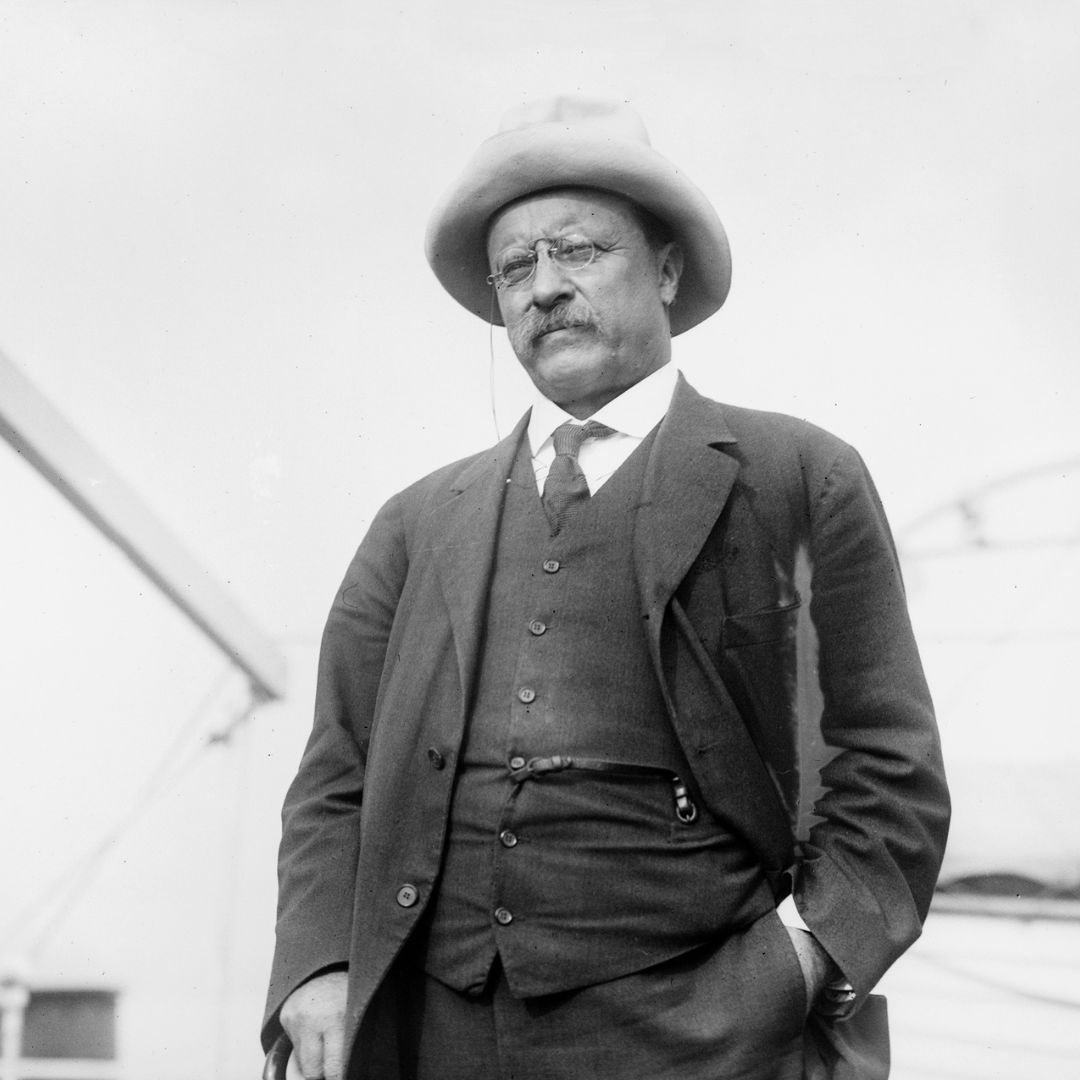
My reply is always Theodore Roosevelt (1858-1919), president from 1901-1909.
I’m not alone in my admiration for our 26th president. In a YouGov poll of the general population, he consistently shows in the top five, among Abraham Lincoln, John F. Kennedy, George Washington and Thomas Jefferson.
Seen as the architect of the modern presidency, Roosevelt’s multi-faceted life is full of energy, leadership, heroism, decisiveness, and loss.
There’s much you probably already know about Theodore Roosevelt: President, Conservationist, Rough Rider, Panama Canal, Mt. Rushmore, and Bull Moose. I won’t dwell on those well-known achievements but rather talk about the man himself.
The Theodore Roosevelt you may not know.
First, he hated the name Teddy, finding it “too juvenile”. He preferred Theodore or later, as Colonel. Also, he had no middle name, and he was a Junior, as his father was Theodore Roosevelt. And yes, he was fifth cousins with future president Franklin D. Roosvelt.
As a child in New York City, he had severe asthma, so much so that his father had to take him out for nighttime carriage rides to force fresh air into his lungs. His father encouraged him to overcome this condition by strengthening his body and mind. He deeply respected his father, which led him to decide to live a strenuous life, emphasizing effort, hardship, and duty over ease and self-indulgence. He also was very nearsighted and began wearing glasses at age thirteen, an event that opened up the world to him.
He married his college sweetheart, Alice Hathaway Lee, in 1880 at age 22 following his graduation from Harvard.
At age 23, his first endeavor after college was to write an influential book, The Naval War of 1812. Still quoted today, the book cemented his reputation as a scholar and writer. He went on to write 46 other books, 33 articles in major publications, and an estimated 150,000 letters.
On Valentines Day, 1884, Alice died two days after childbirth. On the same day and in the same house, his mother, Mittie, died from typhoid fever.
In his grief, he left baby Alice with his sister and moved west to North Dakota to become a rancher. Three years in, he lost his investment in the ranch when all his cattle died during a frigid winter.
In 1886, he returned to New York and married a childhood friend, Edith Carow. They had 5 children plus his first daughter Alice.
After a stint as a police commissioner in New York City, he was appointed Assistant Secretary of the Navy by President William McKinley. During the run up to the Spanish-American War in 1898, Roosevelt advocated for a rapid buildup of preparations. He derided McKinley’s reluctance to declare war by saying “he has no more backbone than a chocolate éclair”.
After his wartime Rough Rider charge up San Juan Hill, his popularity boomed, paving the way for his election as Governor of New York. A reformer at heart, he made the New York politicians so uncomfortable, they strongly recommended Theodore to become the Vice Presidential nominee in the 1900 election with the incumbent McKinley.
President of the United States
McKinley’s second term was short-lived: McKinley was assassinated in Buffalo in 1901. At age 42, Roosevelt became the youngest President in history.
Early in Roosevelt’s presidency, he went on a hunting trip to Alabama, specifically to shoot a bear. After two days without a bear, the local officials trapped a tired old bear, tied it to a tree, and suggested Roosevelt shoot it. Theodore refused, calling it unsportsmanlike. The resulting adulation in newspapers across the country gave an entrepreneur in New York an idea: create a plush, soft, bear toy. It sold out in hours, and the Teddy Bear was born.
In 1904, he created the Roosevelt Corollary to the Monroe Doctrine, saying the USA must be the policeman for the Western Hemisphere because unruly, corrupt smaller nations had to be controlled.
Roosevelt was the first president to win the Nobel Peace Prize for his leadership in settling the Russian Japanese War in 1905. He was the first president to travel outside the country, visiting the under-construction Panama Canal in 1906.
Knowing his affinity for all things naval, in 1907, Roosevelt sent the Great White Fleet, composed of 16 battleships, around the world as a demonstration of formidable US naval power.
Just before he left office in 1909, he put in place new fitness standards for officers in the Army. To show them it could be done, he rode horseback for 100 miles in one day during winter weather.
Post Presidency
Unhappy with his chosen successor, William H. Taft, Roosevelt ran for president in 1912 as leader of the third party Progressive Party, also known as the Bull Moose Party. While campaigning in Milwaukee, he was shot in the chest at close range. The bullet pierced his glasses case and a 50 page folded speech in his breast pocket, stopping short of his heart and lungs. Bloodied, he went ahead with the 90 minute speech before going to the hospital. He told the audience “it takes more than that to kill a bull moose!”
Roosevelt earned more electoral votes than any other third party candidate in history but lost to Woodrow Wilson.
In 1913-1914 he led an expedition to explore the unknown River of Doubt in the Amazon. He nearly died on the long journey in dugout canoes. His son Kermit was there and refused to leave Roosevelt behind when his leg became infected and a fever spiked.
He volunteered to fight in World War I, but President Wilson would not grant him permission. All four of his sons served in the war. Son Quentin was a pilot, dying in a plane crash behind German lines.
Roosevelt was never the same after this loss, dying in less than a year later at age 60.
Enduring Legacy
Roosevelt’s legacy has endured and expanded over the decades. In the 1930’s, his face was included in the memorial at Mt. Rushmore. In 1953, his home at Sagamore Hill New York opened as a museum. In 2001, President Bill Clinton posthumously awarded Roosevelt the Medal of Honor for his exploits as a Rough Rider on San Juan Hill. His son, Theodore Roosevelt Jr., also won the Medal of Honor on the Normandy beaches of World War II.
A new Theodore Roosevelt Museum will open July 4, 2026, in Medora, North Dakota to celebrate this one-of-a-kind man’s life on the prairie.
So, he’s my favorite. Who’s yours?
Interested in learning more about the presidents? Visit the Carolyn & James Millar Presidential Gallery on the upper level of the Booth Western Art Museum. The gallery features original letters and photographs of every U.S. president. Learn more at www.boothmuseum.org.