Chris Binkert

Presidential Nicknames

It seems that presidents cannot just go by their given name.  Once their ‘hat is in the ring’, their followers and opponents both seek to use nicknames to define them, honor them, or deride them.

In modern terms, nicknames can be viewed as a form of branding by positioning the man or woman in a certain light.  Politicians seem to naturally grasp the advantages of a good nickname.

Let’s walk through some of the best presidential nicknames and point out some exceptional choices and recent trends.

Father of our Country, George Washington’s (1789-1797) nickname, is one of honor and respect for his defining role in our evolution as a nation.

Thomas Jefferson (1801-1809):  it’s hard to beat Father of the Declaration of Independence, but he was also known as the Sage of Monticello as well.

In a similar way, Jefferson’s successor, James Madison (1809-1817) was known as the Father of the Constitution.  Due to his short 5 ‘4” stature, he was also called Little Jemmy.

Andrew Jackson (1829-1837) had two nicknames: the most prominent was Old Hickory, given by his army troops who knew him as a stout fighter as strong as hickory.  Jackson also was known as Jackass.  He actually embraced the name and ultimately his Democratic Party adopted the image of a jackass as its symbol.

True to political form, Jackson’s Tennessee protégé James Polk (1845-1849) was called Young Hickory during his campaign for the White House.  Young Hickory promised to only serve one term, bowing out after four years and dying 90 days later.

Abraham Lincoln (1861-1865) had multiple nicknames bestowed upon him. He was known as the Rail Splitter due to one of his early jobs, Honest Abe, and The Great Emancipator due to his authorship of the Emancipation Proclamation.

Rutherford B. Hayes (1877-1881) was known as His Fraudulency, due to the nature of the election that put him in office.  The 1876 race between Hayes and Tilden was so close and rife with fraud and voter intimidation that the election was tossed to a special group of Representatives and Supreme Court Justices called the Electoral Commission for a decision. Hayes won by an 8-7 vote, with political drama and shenanigans abounding, thus conferring Hayes with his nickname.

Theodore Roosevelt (1901-1909) also had multiple nicknames. He was the first president to consistently go by his initials, TR, since he signed memos and letters with his initials. He also was known as the Hero of San Juan Hill for his valor in the Spanish American War, and as the Trust Buster, for his work to break up corporate behemoths like Standard Oil.

Theodore’s cousin, Franklin D. Roosevelt (1933-1945), also went by his initials, making FDR synonymous with his Great Depression-fighting programs and war efforts spanning four successful elections.

“I like Ike” had immediate traction with the public in the election of 1952 for Dwight D. Eisenhower (1953-1961). They used his childhood nickname to spin a memorable slogan for both his election runs in the 1950’s.

This period saw a boom in the use of initials as presidential nicknames. Ike was followed into office by John F. Kennedy (1961-1963), also known as JFK.  Kennedy was followed into office by Lyndon B. Johnson (1963-1969), better known as LBJ.  Johnson used his initials for campaign slogans too, such as “All the Way with LBJ”.

James Earl Carter Jr (1977-1981) was the first president to officially go by a nickname for all his duties. Of course he went by Jimmy, and he has embodied the Jimmy nickname to help define himself.  Somehow James Earl Carter just doesn’t have the same ring as Jimmy. (As of this writing, Jimmy remains in hospice in Plains, and is now just a few weeks away from his 100th birthday!)

Ronald Reagan (1981-1989) also had multiple nicknames.  He was known as The Great Communicator, due to his exceptional public speaking skills honed during his acting career.  He also was known as Dutch, nicknamed by his father.  Finally, Reagan was known as The Gipper, for his movie role as George Gipp, a Notre Dame football player.

William Jefferson Clinton (1993-2001) was widely known as Bill. However, he acquired some extra nicknames too:  Bubba, reflecting his southern charm; Comeback Kid, honoring his political redemption in the 1980’s; and Slick Willie, owing to his skill at talking extemporaneously and effectively on nearly any topic that came up.

A very recent trend is to use their number in presidential history as a nickname. It began with George H. W. Bush going as “41”, followed by his son, George W. Bush going as “43”, and later with Donald Trump going as “45”.

It’s fair to assume that all future presidents will have a nickname or two, just like their predecessors.

Interested in learning more about the presidents? Visit the Carolyn & James Millar Presidential Gallery on the upper level of the Booth Western Art Museum. The gallery features original letters and photographs of every U.S. president. Learn more at www.boothmuseum.org.

2025-01-06T13:26:35-05:00Booth Blog|

The Presidents and Hollywood

There are many reasons why the presidency has vaulted to the heights of pop culture in modern times. One of the contributing factors has been Hollywood and its ongoing portrayal of these men and the dramatization of key events surrounding their time in office.

Movies about the presidents are never big at the box office like Star Wars or a Marvel film. However, some of them have provided a vehicle for best actor performances, memorable casts, and enduring popularity.

To be clear, I’m talking about movies featuring stories about real presidents, not fictional presidents like Harrison Ford (Air Force One), or Kevin Kline (Dave).

Topic

The dramatization of actual presidential crises can make for memorable movies. 13 Days, starring Bruce Greenwood as John F. Kennedy, Steven Culp as brother Robert F. Kennedy, and Kevin Costner as Kenny O’Donnell, is among the best at showing the palpable tensions over our nuclear confrontation with Russia in 1962.

All the President’s Men takes a deep dive into Richard Nixon’s Watergate misadventure that resulted in his resignation in 1974. Nixon himself never appears in the movie, with all the drama built around journalists Bob Woodward (Robert Redford) and Carl Bernstein (Dustin Hoffman) and their work to uncover one of the greatest presidential scandals of all time.

Featured President

The list of presidents whose stories were featured in major films is a long one. Literally hundreds of movies have been made about these men.

The standouts, with multiple movies, includes Washington (Forging of a Nation and We Fight to Be Free), John Adams (HBO series John Adams and The Adams Chronicles), Lincoln (Lincoln and Young Mr. Lincoln), Theodore Roosevelt (The Wind and The Lion and Rough Riders), Franklin Roosevelt (Pearl Harbor and Sunrise at Campobello), John F. Kennedy (JFK and 13 Days), Richard Nixon (Frost/Nixon and All the Presidents Men), Bill Clinton (Primary Colors and The Special Relationship), and George W. Bush (W and Vice).

Actors

A wide range of actors have played a president in a major motion picture. One of the most recognized is Daniel Day-Lewis’ portrayal of Abraham Lincoln in Lincoln in 2012 for which he won the Best Actor award.

Other A-List actors include Cliff Robertson (JFK in PT 109); Nick Nolte (Thomas Jefferson in Jefferson in Paris); Anthony Hopkins (Richard Nixon in Nixon and John Quincy Adams in Amistad ); John Travolta (Bill Clinton in Primary Colors); Robin Williams (Eisenhower in The Butler, and Theodore Roosevelt in Night at the Museum); Paul Giamatti (John Adams); Josh Brolin (George W. Bush in W); Bill Murray (Franklin Roosevelt in Hyde Park on the Hudson); John Cusack (Richard Nixon in The Butler); and Woody Harrelson (Lyndon Johnson in LBJ).

Directors

As you might imagine, movies about a president can attract top name directors as well. Stephen Spielberg has done it twice:  Amistad in 1997 and Lincoln in 2012.

Oliver Stone directed JFK, Rob Reiner took on LBJ, Robert Altman did Secret Honor (about Nixon), John Ford directed Young Mr. Lincoln, and Roger Michell did Hyde Park on the Hudson.

You may wonder about Ronald Reagan, whose claim to fame prior to the presidency was as a successful Hollywood actor. Few movies have yet to be made about his presidency, but you can find Alan Rickman playing Reagan in 2013’s The Butler, with Jane Fonda playing Nancy Reagan. There’s also a documentary-style production from 2011 called Reagan by Eugene Jarecki.

My Favorites

One way to judge how well you like a movie is how many times you’ve seen it.  For me, Lincoln with Daniel Day Lewis, Amistad with Anthony Hopkins, and John Adams with Paul Giamatti are among my favorites, seen multiple times over the years.

Interested in learning more about the presidents? Visit the Carolyn & James Millar Presidential Gallery on the upper level of the Booth Western Art Museum. The gallery features original letters and photographs of every U.S. president. Learn more at www.boothmuseum.org.

2024-12-02T12:07:30-05:00Booth Blog|

Who needs 4 More Years?

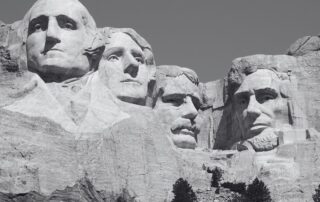
Quick:  how many one term presidents are on Mount Rushmore?

Answer:  none, as Washington, Jefferson, Lincoln, and Theodore Roosevelt all served more than 4 years. By definition of being on Mount Rushmore, they were impactful presidents.

Surprisingly, half of our presidents served one term or less in office. Yes, twenty three of our forty-six presidents had a short time to implement their policies and make a difference.

Among those short-term presidencies, which one was the most impactful?

It’s easy to eliminate William Henry Harrison, since he died only 30 days into his presidency. Five of these men (Tyler, Fillmore, Andrew Johnson, Arthur, and Ford) were vice presidents who ascended to the oval office in an abrupt way due to the death or resignation of the president. They served out the term in unremarkable fashion not to be re-elected.

However, one man became the first ‘dark horse’ candidate to win the White House and did so in part by pledging he would only serve one term and quit.

James K. Polk, Democrat from Tennessee, was little known outside his home state despite having served as the Speaker of the United States House of Representatives. In the presidential election of 1844, the Whigs nominated Henry Clay, a nationally known politician from Kentucky. Polk won the Democratic nomination, beating former president Martin Van Buren and earning the long shot chance to beat Clay.

In the campaign, Polk embraced westward expansion as his primary policy. The annexation of Texas was a hot topic at the time, and Clay came out against it. Polk, better reading public opinion, was fully behind having Texas come into the union. He also endorsed another hot geographical dispute of the day, the Oregon Territory. He agreed we ought to have the northern border as “54/40”, just short of then Russian Alaska. The slogan was “54/40 or Fight”.

Polk also helped his campaign by positioning himself as Young Hickory, a nod to his Tennessee mentor, former president Andrew Jackson. Polk beat Clay 170 to 105 in the Electoral College and took the oath of office on March 4, 1845.

About that time, newspaper editor John O’Sullivan coined the term Manifest Destiny, an all-encompassing concept meant to embrace and encourage westward expansion. The concept assumed the American people’s special virtues and institutions were worthy of replication in the west, the mission to redeem and remake the west in the image of the agrarian east was desirable, and an irresistible destiny was at hand to accomplish coast to coast flourishing of the American way of life.

Newly sworn in President Polk was only too happy to oblige.

Texas was annexed in 1845. The Oregon territorial dispute with Britain was resolved in 1846 at the 49th parallel, bringing all of today’s Washington State and Oregon into the Union.

And Polk wasn’t done yet.

He coveted the vast Mexican held territory of California, Arizona and western New Mexico plus today’s Nevada, Utah, and western Colorado. The question was, how to acquire it?

Mexico and Texas had long disputed the southern border. Mexico believed it was the Nueces River. Texas thought it was the more southern Rio Grande. In 1846, President Polk, as Commander in Chief, purposely positioned armed forces in the disputed territory. When a small fight broke out and some soldiers died, Polk went to Congress for a declaration of war. He won overwhelming support, and the armies, led by Winfield Scott and Zachary Taylor, won the war by finally taking Mexico City.  The Treaty of Guadalupe Hidalgo in 1848 ceded all the Mexican controlled land that Polk wanted for $15 million.

By the end of his one term, James Polk had added immense territories to our country, expanded our coverage to the Pacific Ocean and filled in nearly all the spaces we now know as western states.

Like Jefferson and the Louisiana Purchase agreement with Napoleon in 1803, Polk had a vision of American expansion ‘from sea to shining sea’. That Polk resorted to expansion primarily by force vs. agreement in the case of Mexican possessions remains a much-discussed strategy.

Either way, the one term presidency of James K. Polk goes into the books as the most impactful in our history. Polk, a workaholic, died at age fifty-three, just 90 days after Zachary Taylor succeeded him in 1849.

Interested in learning more about the presidents? Visit the Carolyn & James Millar Presidential Gallery on the upper level of the Booth Western Art Museum. The gallery features original letters and photographs of every U.S. president. Learn more at www.boothmuseum.org.

2024-11-14T14:33:47-05:00Booth Blog|

Georgia and the Presidency

While native son Jimmy Carter has nearly universal awareness for his connections to Georgia, you may be surprised to learn that four other 20th-century presidents also have deep ties to our state.

None of these four men were born in Georgia. That distinction belongs solely to Mr. Carter. However, there are familial, medical, career, and recreational ties that mark Georgia as a significant player in presidential history.

Theodore Roosevelt

New Yorker Theodore Roosvelt’s mother, Mittie, grew up in Savannah, Georgia in the mid-1830’s. In 1839 she moved with her family to an area that would become Roswell, Georgia. Daughter of a wealthy planter, her maiden name was Bulloch, and she grew up in a mansion in Roswell called Bulloch Hall.

Mittie married Theodore Roosvelt Sr. in 1853 and moved to New York City where Theodore Jr. was born in 1858.  As president, Theodore Roosevelt visited Bulloch Hall in 1905 and gave a brief speech honoring his combined northern and southern upbringing.  Franklin Roosevelt, Theodore’s fifth cousin, also visited Bulloch Hall several times. Bulloch Hall remains open to the public in Roswell on Bulloch Avenue.

As a matter of local interest, Dunwoody, Georgia is named after Mittie Roosevelt’s brother, James Dunwoody Bulloch.

Woodrow Wilson

Thomas Woodrow Wilson was born in Staunton, Virginia in 1856. His father was a Presbyterian minister and relocated to Augusta, Georgia before Wilson was two years old. Growing up during the Civil War, Wilson was one of two presidents who are considered true ‘citizens of the confederacy’, the other being John Tyler.

In 1882, Woodrow Wilson set up a law practice in Atlanta, but closed it in less than one year due to his boredom with the day-to-day practice of the law. Three years later, he married Ellen Axon, daughter of a Presbyterian minister from Savannah.  He then pursued studies at Johns Hopkins University, achieving a PhD in history and political science, the sole president to have earned a doctoral degree.

Franklin D. Roosevelt

60 miles southwest of Atlanta is Warm Springs, Georgia, famous for its constant 88-degree waters. Franklin Roosevelt first visited Warm Springs in 1924, three years after his diagnosis with polio. He found the warm water eased his symptoms and he enjoyed the area so much he founded a rehabilitation facility for polio victims.

FDR made 16 trips to Warm Springs while President from 1933 to 1945, staying 2-3 weeks each time. He died in his home there in 1945, just prior to victory in Europe during World War II.

Many subsequent politicians made campaign stops in Warm Springs, including John F. Kennedy and Jimmy Carter (who launched his campaign for the presidency there in 1976 following his nominating victory). Bill Clinton visited in 1995 while in office as well. All three wanted to directly connect to FDR’s popular legacy.


Dwight Eisenhower

Dwight D. “Ike” Eisenhower was an avid golfer and joined the famed Augusta National Golf Club in 1948. His immense popularity for having led the allied forces to victory over Hitler meant that he was rumored to be a candidate for president from both major parties. In 1952 he decided to run as a Republican, winning the office in a landslide.

As president Ike couldn’t just ‘stay’ at Augusta while golfing. He needed a safe and proper home away from the White House.  The membership of the club funded the construction of a ‘cabin’ on the 10th tee of the course for Eisenhower. ‘Cabin’ may be too modest a description for the three story, seven bed room home.  He visited Augusta 29 times during his eight years as president.

The Eisenhower cabin was also used by President Ronald Reagan in 1983 while planning the invasion of Grenada.

Jimmy Carter

No story of presidential impact on Georgia would be complete without mentioning native son Jimmy Carter.  His life in Plains, also birthplace of his wife Rosalynn, his governorship of Georgia and his one term as president mark him as a man of high achievement. He later established the Carter Center in Atlanta, also the site of his library and museum, serving as his home base for his fight for peace and humanitarian causes around the world.

Sea Island

There is one more little-known connection of the presidency to Georgia. Beginning in 1928 with Calvin Coolidge, seven presidents have planted live oak trees at Sea Island Resort. These include Eisenhower in 1946, Ford in 1979, Carter in 1981, H. W. Bush in 1991, W. Bush in 2004, and Bill Clinton in 2012. Each tree is marked with a plaque commemorating their presidency and date of planting.

Most of the sites mentioned here are open to the public. If your travels take you nearby one, I recommend you stop for a visit.

Interested in learning more about the presidents? Visit the Carolyn & James Millar Presidential Gallery on the upper level of the Booth Western Art Museum. The gallery features original letters and photographs of every U.S. president. Learn more at www.boothmuseum.org.
2024-10-28T11:52:17-04:00Booth Blog|

Who’s Up Next?

Since the passage of the 25th Amendment in 1967, we have not had to worry about the line of succession to the presidency.  That much needed amendment added clarity to the topic of succession which had changed multiple times since the beginning of our nation in 1789.

In the course of our history, there have been 18 instances of the office of Vice President being vacant. Half of those vacancies were caused by the death or resignation of the president, upon which the Vice President automatically ascended to the presidency as per Article II, Section 1 of the Constitution.  The other half of the vacancies were caused by the death or resignation of the Vice President, leaving the office vacant.

In all the 18 instances, a line of succession was tapped to put in place an ‘acting president’ should the president die or become unable to serve. And that’s where the story gets interesting.

There were three occasions where there was a vacancy, with no person in line at all!

The first line of succession law was signed in 1792, placing the President Pro Tempore of the Senate as first in line, followed by the Speaker of the House of Representatives.  A Georgian, William H. Crawford, was the first to fill this role in 1812 due to the death of Vice President George Clinton. Crawford, then President Pro Tempore of the Senate, served 11 months as first in line while James Madison was president.

In 1841, President William Henry Harrison died after 30 days in office, elevating Vice President John Tyler.  This first ever occurrence of the death of the president was not at all clear cut in terms of succession. Some felt that Tyler was merely the temporary acting president, not fully The President. Tyler was convinced the framers of the Constitution meant for him to be fully empowered as president. He took the presidential oath of office. He returned unopened, any correspondence that did not address him as President of the United States. Ultimately, the House and Senate voted to accept his title as President, ending the drama and ensuring smooth ascensions in future years.

Following the death of President Zachary Taylor in 1850, Vice President Millard Fillmore stepped up to be the president.  So, the office of VP was open.  However, at that moment, there was no President Pro Tempore of the Senate in office, nor was there an eligible Speaker of the House.  This vacancy lasted only 3 days before William King was elected President Pro Tempore of the Senate and becoming first in line.

In 1881, the same scenario played out.  President Garfield was assassinated, elevating Vice President Chester Arthur. Without a President Pro Tempore of the Senate nor a Speaker of the House, the vacancy lasted 3 weeks.

During the first term of Grover Cleveland in 1885, the Vice President, Thomas Hendricks, died in office. It took 2 weeks this time to fill the vacancy with John Sherman, President Pro Tempore of the Senate.

A second Succession Act was signed into law in 1886.  This legislation dropped the President Pro Tempore and Speaker of the House off the list entirely, putting non-elected cabinet officers in the line of succession for the first time. The Secretary of State was first in line, followed by the Secretary of the Treasury.  John Hay, Secretary of State, who initially served as an executive secretary for Abraham Lincoln, was tapped on two occasions to be the next in line for the presidency, once for 16 months under William McKinley, and once for 43 months under Theodore Roosevelt.

A third Succession Act was passed in 1947, signed by Harry Truman.  Truman, serving without a Vice President due to the death of Franklin Roosevelt in 1945, wished to see the line of succession changed back to elected officials vs. appointed cabinet secretaries.  He was able to get the Speaker of the House placed in first position, followed by the President Pro Tempore of the Senate.

As you could tell, there was no mechanism to put in place a new Vice President if that office became vacant. The 25th Amendment became law in 1967. It allows for the president to nominate a new Vice President and seek approval from both houses of Congress.

Since then, the office of Vice President has been vacant twice, both under Richard Nixon.  In 1973, Vice President Spiro Agnew resigned. 8 weeks later, Gerald Ford was approved as the new Vice President.  In 1974, Richard Nixon resigned the presidency, elevating Ford.  5 months went by before former New York Governor Nelson Rockefeller was approved as the new Vice President.

While much of this may seem of small importance, for the majority of our 234 years as a nation, we suffered uncertainty about who might succeed a president. Now, given the importance of the president as leader of the free world, we can more fully appreciate the value of the 25th amendment, offering clarity to this most important topic.

Interested in learning more about the presidents? Visit the Carolyn & James Millar Presidential Gallery on the upper level of the Booth Western Art Museum. The gallery features original letters and photographs of every U.S. president. Learn more at www.boothmuseum.org.

2024-10-21T14:50:09-04:00Booth Blog|

The Best Position from which to Achieve the Presidency

It’s a good time to ask:  based on our history of 46 presidents, what is the most likely office or position from which to attain the presidency?

This question is more important than you might think, since it gets to the core of candidates’ backgrounds, experiences, and formative processes—things that could give voters a hint of how they might perform in the office.

Putting your name on a national ticket implies a certain level of “name recognition” that is likely to be critical to securing campaign funds and ultimately, the votes needed for election.

So, where do the successful candidates get such awareness plus experience to qualify in voter’s eyes?

The VPs

Either rising directly from the Vice Presidency or having been a Vice President is the most common route to the top office. 15 of our presidents served as Vice President. Eight of these ascended due to the death in office of the president, four were directly elected to the presidency, two were elected after being out of office, and one following a resignation.

Out of Office is OK

Twelve presidents were out of elected office immediately prior to winning the presidency. Almost all of them, however, had held an elected office in the past. Richard Nixon and Joe Biden are the two former Vice Presidents who were elected president later in their careers. Grover Cleveland had been president in the past when he was elected a second time (non-consecutive). Two had been Governors of large states: (Reagan of California and Carter of Georgia).

Three had been US Senators: William Henry Harrison, Franklin Pierce, and Benjamin Harrison. It should be noted that these men became Senators at a time when they were appointed by their state governments, not elected by the voters of their states.

One, James K. Polk, had been Speaker of the House of Representatives, the only president to have held that position. One had been a Congressman (Lincoln); two had military backgrounds (Washington and Jackson).

Governors

Seven presidents were state governors immediately prior to winning the White House. They came primarily from big states such as Ohio (William McKinley and Rutherford Hayes), New York ( Grover Cleveland and Franklin Roosevelt), Texas (George W. Bush), and New Jersey (Woodrow Wilson). Only Bill Clinton was Governor of a small state, Arkansas.

In total, seventeen of our presidents achieved the position of state governor at some point prior to taking over the oval office, giving them administrative and statewide electoral experiences.

Senators

Only three Senators have risen directly to the presidency, all three in modern times where they won their seat in a statewide election, thus creating more awareness of their names. Those men were: Warren Harding of Ohio, John F. Kennedy of Massachusetts, and Barack Obama of Illinois.

Cabinet Officer

Given the visibility of the people serving in these positions, you might imagine it could be a springboard to the presidency.  But only three presidents achieved it directly from the office of Secretary of State. However, they were all from our distant past (Madison, Monroe, John Q. Adams), and none of the modern Secretaries of State have made it to the top office.

Two other cabinet officers have made it:  William Howard Taft was Secretary of War (now called Defense), and Herbert Hoover as Secretary of Commerce. Both men held other positions of national stature prior to serving in the cabinet, thus pushing their names out there for awareness among the voting public.

Military Heroes

We’ve elected military heroes directly to the office of the president three times: Zachary Taylor after the Mexican American War, Ulysses Grant after the Civil War, and Dwight Eisenhower after World War II. Only one of these men, Eisenhower, could effectively translate their military training and experience to success in the office. Taylor died less than halfway through his first term, and Grant, although elected twice, was mediocre at best.

Unique Ascensions

One office that’s missing in this discussion is that of Congressman or US Representative. Only one man ever rose to the presidency directly from that office:  James Garfield of Ohio, elected in 1880.  Garfield was unique in one other regard:  he’s the only ordained minister ever in the White House.  His presidency was cut short by an assassin after only four months in office.

Donald Trump was certainly unique: he was elected president without having filled any of the positions listed above.

Based on the 46 presidents in our history, the most likely path to the office is via the vice presidency or a state governorship. Senators, Congressmen, or cabinet officers are far less likely to be successful in a quest for the White House.

Interested in learning more about the presidents? Visit the Carolyn & James Millar Presidential Gallery on the upper level of the Booth Western Art Museum. The gallery features original letters and photographs of every U.S. president. Learn more at www.boothmuseum.org.

2024-10-10T11:18:57-04:00Booth Blog|

The Parks and the Presidents

It’s time for a quiz:  Which of the following presidents signed off on the most new national parks?

  1. Jimmy Carter
  2. Theodore Roosevelt
  3. Franklin Roosevelt
  4. Woodrow Wilson

Often called America’s Best Idea, the National Parks are an enduring symbol of conservation efforts, intricately associated with many of our presidents.

Nearly every president since Ulysses Grant has visited the national parks for recreation, to boost tourism, or to make a political statement on their support for conservation.

Most historians do not give Grant high marks for his time in office. However, his most enduring act was proclaiming Yellowstone our first national park in 1872.  It was a startling, revolutionary American concept at the time, first in the world.  Grant, with congressional legislation, formally took public land and set it aside in perpetuity for future generations. No longer would such pristine natural places of wonder be left to developers, miners, and profiteers.

By the time Theodore Roosevelt became president in 1901, there were 4 national parks. Theodore, a lifetime conservationist, and close friend of John Muir, wasted little time in expanding the number of parks from 4 to 7, bringing on Crater Lake in Oregon, Wind Cave in South Dakota, and Mesa Verde in Colorado.  But he didn’t stop there. At his urging, Congress passed the Antiquities Act of 1906. This act has been used extensively to create hundreds of national: monuments, seashores, forests, and recreation areas in all 50 states.  With a stroke of his pen, Roosevelt created the first 18 national monuments, such as the Devil’s Tower in Wyoming.

By the time of Woodrow Wilson’s presidency (1913-1921), the parks needed serious help. They were underfunded, undermanaged, and lacked coherent guidelines to endure for the long run.  Poaching, grazing, and drilling were difficult to control.  Congress passed and Wilson signed the Organic Act of 1916 that established the National Park Service, provided structured leadership, and added funding that would assure the long-term preservation of the parks. It also acknowledged the value of tourism to the long run viability of the parks, thereby setting up an enduring Ying and Yang between preservation and tourism.

While in office, Wilson signed off on 7 new parks, the third highest of any president. Grand Canyon was one he elevated from national monument status to full national park.

Calvin Coolidge loved the parks too. In August 1927 he vacationed in the Black Hills of South Dakota, presenting Gutzon Borglum with 6 steel drill bits to kick off the carving of Mount Rushmore National Monument.

Franklin Roosevelt, elected 4 times, had time to bring 8 national parks into the system, the second highest of any president.  Great Smokey Mountain National Park, the most popular of all the parks, was one of his first in 1934. He also brought in one of the least visited parks, Isle Royale, an island in Lake Superior.

Beyond the 8 parks, Franklin Roosevelt signed an Executive Order in 1933 that further organized the park service, bringing unity of supervision to parks, monuments, battlefields, property in the nation’s capital, and sites such as George Washington’s home at Mount Vernon.  His Civilian Conservation Corps also used Great Depression funding to build roads, lodges, ground erosion, and infrastructure for the parks from 1933 to 1942.

With a solid understanding of the American public’s love of the parks, every president since Dwight Eisenhower has signed off on at least one new national park, bringing today’s total to 63 parks.  As evidenced by the fact that 54% of the parks were created since 1961, these presidents all want the afterglow of national parks as part of their legacy.

None more so than the son of Georgia, Jimmy Carter, who signed off on 10 new parks during his single term of office, the most of any president. The Alaska National Interest Lands Conservation Act of 1980 created 6 parks in the 49th state. He also signed off on Theodore Roosevelt National Park in North Dakota, honoring TR for his monumental contributions.

Carter used the Antiquities Act of 1906 to create the Chattahoochee River National Recreation Area that many of us have visited on the north side of Atlanta.

If your answer to the quiz was Jimmy Carter, you get an A+.

If you’re like me, you really enjoy visiting these magnificent parks.  Next time you take one in, pause, and consider how this Best Idea has enhanced your life and brought a glowing legacy to the presidents involved in their creation.

Interested in learning more about the presidents? Visit the Carolyn & James Millar Presidential Gallery on the upper level of the Booth Western Art Museum. The gallery features original letters and photographs of every U.S. president. Learn more at www.boothmuseum.org.

2024-09-25T16:25:33-04:00Booth Blog|

Foiled Assassinations

Presidential assassinations are a sad reality in American political history. Four presidents have died at the hands of murderous gunmen:  Abraham Lincoln in 1865, James Garfield in 1881, William McKinley in 1901, and John F. Kennedy in 1963. 

However, there is a long list of attempted assassinations, foiled plots, jammed pistols, and deranged people who have tried to kill the president while in office, recently elected to the office, or earlier in their national careers.

Of the four presidents on Mt. Rushmore: Washington, Jefferson, Theodore Roosevelt, and Lincoln, three were targeted for death by opponents. Only Thomas Jefferson was never attacked. 

Here are some of the less familiar attempts:

George Washington:  Yes, someone plotted to kill Washington while he led the Revolutionary Army in 1776.  A British loyalist, Thomas Hickey, infiltrated Washington’s Life Guard protection group.  While jailed on suspicion of counterfeiting, he bragged about the murderous plot and was tried for treason and sedition. He was hanged before 20,000 people in New York two days after the trial, with the intent to make an example to deter others.

Abraham Lincoln: His assassination by John Wilkes Booth in 1865 is well known. However, nine months earlier, as he rode a horse three miles from the White House to the Soldier’s Home, an assassin fired at him from the side of the road.  The shot knocked his signature stovepipe hat off his head. As Lincoln rode on unhurt, soldiers picked up the hat and saw the bullet hole through the brim.  

In a historical twist, Lincoln signed the law creating the Secret Service on the day of his assassination, April 14, 1865. The intent was to stop counterfeiters.  Its mission was expanded to include presidential protection in 1901 after McKinley’s assassination.

Theodore Roosevelt: assuming the presidency after McKinley’s assassination in Buffalo in 1901, Theodore pursued the White House once more in 1912 while out of office. Running as the candidate of the Bull Moose Party, he was shot at close range by John Schrank in Milwaukee as he exited his car to deliver a speech.  The bullet struck his glasses case and 50-page speech in his breast pocket. While bleeding, he gave the speech anyway, saying “It takes more than one shot to kill a Bull Moose”.

John F. Kennedy: President–Elect Kennedy, the first Catholic president, was targeted by Richard Pavlick in 1960. Pavlick, from Boston, hated Catholics and decided to kill Kennedy. He was ready to detonate explosives as Kennedy was attending church, but ultimately decided not to do it in the presence of Kennedy’s family. Three years later on November 22, 1963, Lee Harvey Oswald would kill Kennedy in Dallas.

Richard Nixon: in April 1974, six months before Nixon resigned the presidency, Samuel Byck planned to hijack a commercial airliner and fly it into the White House to kill President Nixon. He commandeered a Delta airliner in Baltimore, shot both pilots because they refused to fly him to Washington, and committed suicide after being wounded by police.

Bill Clinton: airplanes were again used to target the president in 1994. A veteran named Frank Corder stole a small plane while drunk and flew it to the White House. He crashed on the White House lawn and was killed. President Clinton was not in the White House at that time, living across the street at Blair House due to renovations.

George W. Bush: while giving a speech in Tbilisi, Georgia in 2005, an assassin threw a live grenade toward the stage where Bush was speaking. It failed to detonate because the assassin, Vladimir Arutyunian, had wrapped it too tightly with a handkerchief.

Barack Obama: while no one ever shot at him, President Obama received an unusually large number of threats. In 2013 a man sent him a letter filled with ricin, a deadly poison. The sender originally appeared to be an Elvis impersonator named Kevin Curtis from Tennessee. However, in a convoluted scheme, a rival of Curtis, Everett Dutschke, had tried to pin the attempt on Curtis. Dutschke remains in prison serving a 25-year sentence.

Other presidents were targeted yet survived in other more publicized attempts:  including Andrew Jackson (two pistols jammed, saving him), Franklin Roosevelt (shots missed FDR but killed the mayor riding with him), Harry Truman (two Puerto Rican assassins stormed the Blair House while Truman was in residence) , Gerald Ford (Squeaky Fromme’s pistol didn’t fire; two weeks later Sarah Moore’s shot missed) and Ronald Reagan (John Hinckley Jr. fired multiple shots, one of which nearly killed Reagan).

Being one of the most visible and at times polarizing figures in the world leads some people to go to extreme measures to eliminate them. Thankfully, the Secret Service has evolved into a robust protective force that has prevented assassinations for the past 60 years. Let’s hope they continue that record of achievement.

Interested in learning more about the presidents? Visit the Carolyn & James Millar Presidential Gallery on the upper level of the Booth Western Art Museum. The gallery features original letters and photographs of every U.S. president. Learn more at www.boothmuseum.org.

2024-09-20T12:10:28-04:00Booth Blog|

Presidential Health: To Tell or Not to Tell

While it’s clear that the President is under no specific obligation to disclose anything about their health, our country has an evolving point of view about it.

Until recent decades, presidents routinely kept any health issues to themselves and close associates. However, for several reasons, more recent presidents have been more forthcoming, even releasing results of exams, tests, and routine checkups.

What was the key driver of a change toward more open disclosure of the president’s health?  Many point to the beginning of the nuclear age in 1945, with the advent of powerful weapons that require a fully functioning and vigilant president.  The public should know when the awesome power to launch nuclear war with the survival of mankind in the balance is in the hands of a person who is physically or mentally unwell.

The evolution was memorialized in the 25th Amendment to the Constitution in 1967.  That amendment, among other things, allows a president to transfer the powers of his office formally and temporarily to the vice president.  George W. Bush was the first to use the 25th Amendment for that purpose, transferring power to Dick Cheney during his colonoscopy in 2002. Joe Biden recently did the same this past November. Interestingly, Ronald Reagan did not use the 25th when he underwent colon surgery in 1985.

That’s a far cry from Grover Cleveland’s decision, in 1893, to not tell the public of his rapidly spreading cancer of the mouth.

Early in Cleveland’s second (a non-consecutive) term, the economic Panic of 1893 gathered speed and threatened to ruin the country. Cleveland felt if he told the public about his cancer, it would add fuel to the panic and make things much worse.  Also, it had only been a few years since President US Grant died of cancer of the throat, stigmatizing the disease. So, Cleveland decided to pursue a path of deception, lies, and smear tactics to keep the secret.

Cleveland told the public he was going on a fishing trip. He was seen boarding a ship to begin the journey. On board were 6 surgeons, all sworn to secrecy, who were standing by to operate on the president. In a 90-minute operation they removed the tumor on the roof of his mouth, 5 teeth, and part of his jawbone, all extracted via his mouth. There were no external incisions, and he retained his trademark moustache. After 4 days, he disembarked on Cape Cod as planned. A short time later, he was fitted for a prosthetic jawbone in a second surgical procedure and spent time learning to speak clearly with it in place.

By now you may be thinking ‘shouldn’t someone have figured this out?’  And you would be right.

2 months after the surgery, E. J. Edwards, a reporter for the Philadelphia Press, broke the whole story wide open when he got it confirmed by one of the surgeons, dentist Ferdinand Hasbrouck.

Did the President then acknowledge the deception?  No.  Cleveland proceeded to conduct a smear campaign to discredit the reporter and did so in such a comprehensive way that the lie was squelched for 24 years, long after Cleveland was deceased. It resurfaced only because another of the surgeons, W. W. Keen, decided to tell the truth and vindicate the reputation of the reporter.

Was Cleveland right to place his duty to protect the public above the public’s need to know? Given the situation and the times, some would say yes.

Later, and more seriously, Woodrow Wilson’s catastrophic stroke in late 1919 and his resultant incapacity was kept hidden by his wife and doctor. They conspired to keep the public and the Congress in the dark about his severe condition for 15 months until the end of his second term in office.

Compared to Cleveland, Wilson most certainly went too far. He should have resigned for health reasons.

The recent discussions concerning Joe Biden’s mental acuity provides a challenging situation. While he and his doctors proclaim his fitness for office, public debates and appearances cast serious doubts.  His future remains uncertain at this time.

In the 21st century it’s fair to say that the times have changed. The speed and pervasiveness of instant communications, smart phones, and cameras, plus the added value of the 25th Amendment, have made it more advantageous for the president to be forthcoming and place the American public in the know about their health.

Deception is out. Disclosure is in.

Interested in learning more about the presidents? Visit the Carolyn & James Millar Presidential Gallery on the upper level of the Booth Western Art Museum. The gallery features original letters and photographs of every U.S. president. Learn more at www.boothmuseum.org.
2024-09-10T14:07:29-04:00Booth Blog|

The Evolution of Our National Holidays

For many of us, the Memorial Day weekend is the official start of summer, bringing forth three national holidays and providing welcome chances to hit the road, entertain guests, or just relax.

This got me wondering about the role of the presidents in creating the national holidays.

For the first 87 years of our nation’s history (1776 – 1863), there were no official national holidays.  While many states had various holidays and days of celebration, there were none at the federal level.

Abraham Lincoln got the ball rolling in 1863 when he declared Thanksgiving to be a national holiday on the last Thursday of November.

Then in 1870, President U. S. Grant signed off on legislation to create the first set of national holidays:  New Year’s Day, 4th of July, Thanksgiving Day, and Christmas Day.

Realizing they were on to something popular, politicians began extending the concept of national holidays.

Memorial Day

In May 1868, three years after the end of the Civil War, soldiers established Decoration Day, urging citizens to decorate the graves of war dead with flowers, wreaths, and flags.  A large celebration was held at Arlington National Cemetery. One of the speakers was Congressman, Civil War General and future president James A. Garfield who said the deceased soldiers had “made immortal their patriotism.”

Later, after World War I, the definition of Decoration Day was expanded to include soldiers of all American wars, not just the Civil War.  Thus began the trend toward calling it Memorial Day, a reality not officially recognized by the federal government until 1971 thanks to legislation signed in 1968 by President Lyndon Johnson.

Presidents Day

The first national holiday to celebrate an individual was in honor of George Washington’s birthday on February 22. It was created in 1879 by President Rutherford B. Hayes and only covered Washington DC. In 1885, under President Grover Cleveland, Washington’s Birthday became a national holiday.

While no one begrudged Washington the honor, some wondered why Abraham Lincoln, also born in February, was also not recognized.  After decades of debate, in 1968, Washington and Lincoln’s birthdays were combined into Presidents Day and set up on the third Monday of February.  Lyndon B. Johnson signed this legislation, called the Uniform Monday Holiday Act, that not only created Presidents Day, but also moved Memorial Day, Labor Day, and Veterans Day to Mondays, creating three-day weekends and, in theory, to boost retail sales and reduce workplace absenteeism.

Labor Day

Following years of labor unrest in the 1880s and growing popular sentiment, in 1894 Grover Cleveland, in the second of his non-consecutive terms, signed legislation making Labor Day a national holiday on the first Monday in September.

Columbus Day

Franklin Roosevelt created Columbus Day as a national holiday in 1937 to recognize the explorer’s arrival in the New World in 1492. It is now referred to as Indigenous Peoples Day by 19 states who recognize the indigenous communities that have lived in the Americas for thousands of years.

Armistice Day

President Franklin D. Roosevelt signed legislation creating Armistice Day in 1938 to recognize the end of hostilities in World War I. It would be celebrated on November 11 each year.  In 1954, under President Dwight D. Eisenhower, famed Supreme Allied Commander in World War II, the holiday was renamed Veterans Day to expand the concept of recognition to include World War II and the Korean War.

Thanksgiving with a Twist

As mentioned above, President Lincoln authorized a day of Thanksgiving on the last Thursday of November.  However, in 1938, during the depths of the Depression, President Franklin D. Roosevelt tried to switch Thanksgiving Day to the next to last Thursday of November, thinking it would boost sales and revenue by extending the Christmas shopping season.  He persisted in this for three years with a proclamation as to the new date for celebrating.  He had to finally give up the idea, signing legislation on December 26, 1941, permanently making Thanksgiving Day the fourth Thursday of November.

Recent New Holidays

Since 1968 only two additional national holidays have been created. In 1983, Ronald Reagan signed off on the creation of Martin Luther King, Jr. Day, observed on the third Monday in January, King’s birth month.

Recently, in 2021, Joe Biden created Juneteenth Day to celebrate the emancipation of enslaved African Americans, as reflected in the June 19, 1865, General Order No. 3 issued by Major General Gordon Granger which notified the people of Texas that all slaves in former Confederate States were free.

As we swing into summer and encounter multiple national holidays, consider the evolution of these important days and their real and symbolic roles in our American life.

Interested in learning more about the presidents? Visit the Carolyn & James Millar Presidential Gallery on the upper level of the Booth Western Art Museum. The gallery features original letters and photographs of every U.S. president. Learn more at www.boothmuseum.org.
2024-08-29T14:49:47-04:00Booth Blog|
Go to Top