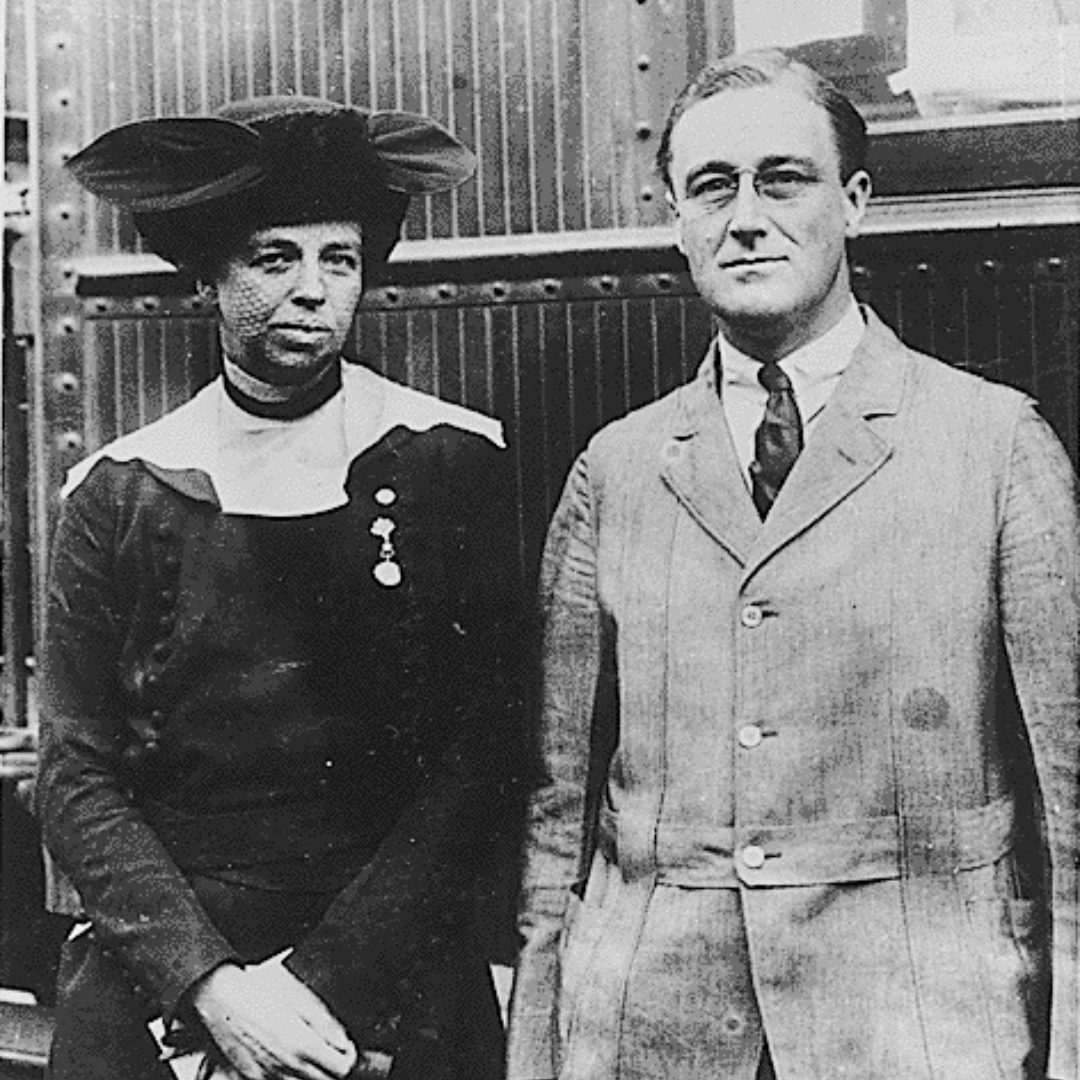
Written by Chris Binkert | Photo: Franklin D. Roosevelt Presidential Library and Museum
They are close to political power but are not elected. They are not paid for their services. They can be helpful to presidents, sometimes representing the president in foreign and domestic venues. In one case, they were rumored to be ‘acting president’.
Who are these people?
Yes, you’ve got it…. It’s the First Ladies.
From Martha Washington to Jill Biden, our country’s chief executive has been supported by a woman who takes on multiple duties for free. They frequently take on projects and issues important to themselves and the president. In modern times they have a large support staff of their own.
However, not all these First Ladies were the wives of the president. If the president is not married, is a widower, or his spouse is unable to serve, women close to the president have been asked to take on the role. 13 women who were not the wife of the president have served as First Lady. The first instance of this was in the Thomas Jefferson administration (1801-1809). His wife died in 1782. Therefore, Jefferson asked his daughter, Martha Jefferson Randolph, to help with social duties.
First Lady Rankings
As with the presidency, the First Lady’s role has expanded over the years and is also subject to ranking exercises by historians. Siena College has published a ranking of First Lady’s every ten years since the early 1980s, most recently in 2013. Historians are asked to rate First Ladies on ten factors, including background, value to the country, integrity, leadership, intelligence, accomplishments, being her own woman, courage, public image, and value to the president. The top three are:
- Eleanor Roosevelt
- Abigail Adams
- Jacqueline Kennedy
Eleanor Roosevelt (Franklin Roosevelt) has ranked as the number one First Lady in each edition of the Siena survey. Her 12 years in the White House allowed her extensive time to pursue humanitarian rights, civil rights, plus write a weekly news column, hold press conferences, and travel the world as the president’s ‘eyes and ears’.
Abigail Adams (John Adams) was an early advocate of women’s causes and worked to abolish slavery.
Jackie Kennedy needs little introduction. In her short 1,000 days as First Lady she undertook a historic restoration of the White House, famously giving a televised tour of the results and winning an Emmy Award for her work. Her courage, dignity, and steadiness at age 34 in the aftermath of JFK’s assassination in 1963 made her a heroic figure among First Ladies.
First Lady Perspectives
The youngest First Lady was Frances Cleveland, who married Grover Cleveland in the White House at age 21. Upon Cleveland’s defeat in the election of 1888, she famously said to the White House staff “keep all in order here, as we’ll be back in four years.” Grover won back the White House in 1892, making Frances the First Lady once more.
The longest lived First Lady was Bess Truman, who passed at age 97. She met Harry Truman in the 5th grade in Independence Missouri.
Three First Ladies died while their spouse was president. First was Letitia Tyler who died of a stroke in 1842. Her husband John Tyler then married Julia Gardiner, who requested that Hail to the Chief be played at every presidential appearance, which continues to this day.
The second First Lady to pass way in office was Caroline Harrison, wife of Benjamin. She died of tuberculosis 2 weeks before the election of 1892 in which her husband was defeated by Grover Cleveland. This enabled Cleveland to become the first and only non-consecutive president. Benjamin Harrison subsequently married Caroline’s niece, 25 years younger than himself.
The last First Lady to die while in office was Ellen Wilson, who succumbed to kidney disease in 1914. One of her accomplishments was the creation of the Rose Garden at the White House.
Her husband Woodrow soon married Edith Boling Gault. It was Edith who some say became ‘acting president’ when Woodrow had a massive stroke in 1919. She collaborated with his doctor to screen all his visitors, read all his correspondence, and kept the world at bay for many months until he left office in early 1921.
In 1912, Helen Taft, William Howard Taft’s wife, made a lasting contribution to the Washington DC scene by accepting a gift from Japan to plant 3,000 blossoming cherry trees around the Tidal Basin.
In 1965, Congress passed the Highway Beautification Act, a priority project for Lady Bird Johnson. We can thank her for advocating to have better control of outdoor advertising on Interstate Highways and Federal roads.
More contemporary First Ladies have taken up special causes as their signature effort to connect with America. Nancy Reagan’s was Just Say No to drugs. Barbara and Laura Bush both advocated for childhood literacy. Rosalynn Carter’s cause was mental health.
As the role has evolved, the First Lady has played an ever more visible part of the presidency, many times winning approval ratings well above their husband’s.