booth

About booth

This author has not yet filled in any details.
So far booth has created 2363 blog entries.

John Lomax III: Preserving Western Music One Song at a Time

Saturday, March 8, 2025, 1:00 PM

The Booth Western Art Museum invites the community, and Gala & Art Auction attendees, to John Lomax III: Presenting Western Music One Song at a Time, on Saturday, March 8 at 1:00 PM.

Our guest speaker will be John Lomax III, a former national-level music talent manager. On his 80th birthday, John released his debut CD American Folk Songs, featuring material gleaned from the work of his father and grandfather. The latter is the famed Western music historian and musicologist John Avery Lomax, who was the original chronicler of classic Western songs such as “Home on the Range”. Were it not for his publications such as Cowboy Songs and Other Frontier Ballads and Songs of the Cattle Trail and Cow Camp, many of the most cherished cowboy and western songs may have been lost to history. During this lively program, Director Seth Hopkins will interview Lomax III and he will sing Western classics in a traditional cowboy style.

Included in General Admission and FREE for Booth Museum Members.

Inauguration Day Dramas and Snubs

As a country, we celebrate the peaceful transfer of power from one president to the next every four or eight years.  It’s one of the hallmarks of our democracy.

But just because Inauguration Day has witnessed a peaceful transfer doesn’t mean it has lacked drama, snubs, personal insults, bickering, and outright escape.

It’s important to put this day in historical context.  Since 1933 and the passage of the 20th Amendment, January 20 has been Inauguration Day. For the prior 148 years, it was held on March 4. It took an Act of Congress and ratification by the states to shorten up the lame duck period once our transportation systems allowed for speedier transitions.

Let’s look at some of those dramas, snubs, and insults.

Our second President, John Adams, refused to attend the inauguration of his successor, Thomas Jefferson, in 1801. The brutal campaign and name calling by Jeffersonians apparently turned off Mr. Adams and he escaped town in his carriage just after midnight rather than see his rival take his place. Interestingly, Adams son, 6th President John Quincy Adams, also refused to watch his bitter rival, Andrew Jackson, sworn in as well.

The Adams men were crusty types, but John Quincy was not the last President to fail to show for the event.

In 1869, Andrew Johnson, having been defeated for re-election by war hero Ulysses Grant, did not attend, since he felt snubbed by Grant’s refusal to ride with him to the Capitol ceremony.  Johnson, the first to be impeached, was despised by many, and Grant was one of them.

Andrew Jackson’s inauguration in 1829 and the following open house led to mayhem when 20,000 people descended on the White House to celebrate. They broke furniture, spilled food and drink, ripped curtains for souvenirs, and forced Jackson to escape the crush by exiting via a window while his butlers placed tubs of drinks on the lawn to lure the boisterous crowd outside.

Politics had much to do with Herbert Hoover’s frosty ride to the Capitol with Franklin D. Roosevelt in 1933. They didn’t say a word to each other the whole ride. Roosevelt was determined to hang the Great Depression around Hoover’s neck and had refused to discuss any federal initiatives to mitigate the economic suffering between election day and inauguration day. FDR was not about to toss Hoover a lifeline, preferring to let him take the fall instead.

As you might expect, there are several traditions that take place on inauguration day, including luncheons after the swearing in, parades, and nighttime balls. One of those traditions was broken by Dwight Eisenhower in 1953. The outgoing president and first lady host a small coffee and tea reception in the White House before motoring to the Capitol.  Harry and Bess Truman had it all set up and ready to go, but the Eisenhower’s refused to come inside because they arrived late.  Truman was insulted and they bickered back and forth the whole ride to the event.

Inauguration day requires a major speech by the president, and the timing and context of the transition has made for both dramatic and unfortunate history.  For drama, it’s hard to beat FDR’s “All we have to fear is fear itself” with respect to the Great Depression, or JFK’s “Ask not what your country can do for you — ask what you can do for your country”, as he called for the torch to be passed to a new generation.

Unfortunately, the longest inaugural address was given by William Henry Harrison in 1841. A monster at over 8,400 words and 2 hours, it’s said that he gave the speech without a coat in a sleet storm to show that at age 68 he was fit to handle the presidency. Sadly, he caught pneumonia and was dead within a month.

Our most recent inauguration was in January 2021.  Joe Biden was sworn in; however, Donald Trump did not attend.

Those in the know will be looking for any insider drama this coming January 2025. It’s part of the fabric that endures to make the peaceful transfer of power a foundational principle for all time.

Interested in learning more about the presidents? Visit the Carolyn & James Millar Presidential Gallery on the upper level of the Booth Western Art Museum. The gallery features original letters and photographs of every U.S. president. Learn more at www.boothmuseum.org.

2025-01-20T14:30:40-05:00Booth Blog|

Presidential Nicknames

It seems that presidents cannot just go by their given name.  Once their ‘hat is in the ring’, their followers and opponents both seek to use nicknames to define them, honor them, or deride them.

In modern terms, nicknames can be viewed as a form of branding by positioning the man or woman in a certain light.  Politicians seem to naturally grasp the advantages of a good nickname.

Let’s walk through some of the best presidential nicknames and point out some exceptional choices and recent trends.

Father of our Country, George Washington’s (1789-1797) nickname, is one of honor and respect for his defining role in our evolution as a nation.

Thomas Jefferson (1801-1809):  it’s hard to beat Father of the Declaration of Independence, but he was also known as the Sage of Monticello as well.

In a similar way, Jefferson’s successor, James Madison (1809-1817) was known as the Father of the Constitution.  Due to his short 5 ‘4” stature, he was also called Little Jemmy.

Andrew Jackson (1829-1837) had two nicknames: the most prominent was Old Hickory, given by his army troops who knew him as a stout fighter as strong as hickory.  Jackson also was known as Jackass.  He actually embraced the name and ultimately his Democratic Party adopted the image of a jackass as its symbol.

True to political form, Jackson’s Tennessee protégé James Polk (1845-1849) was called Young Hickory during his campaign for the White House.  Young Hickory promised to only serve one term, bowing out after four years and dying 90 days later.

Abraham Lincoln (1861-1865) had multiple nicknames bestowed upon him. He was known as the Rail Splitter due to one of his early jobs, Honest Abe, and The Great Emancipator due to his authorship of the Emancipation Proclamation.

Rutherford B. Hayes (1877-1881) was known as His Fraudulency, due to the nature of the election that put him in office.  The 1876 race between Hayes and Tilden was so close and rife with fraud and voter intimidation that the election was tossed to a special group of Representatives and Supreme Court Justices called the Electoral Commission for a decision. Hayes won by an 8-7 vote, with political drama and shenanigans abounding, thus conferring Hayes with his nickname.

Theodore Roosevelt (1901-1909) also had multiple nicknames. He was the first president to consistently go by his initials, TR, since he signed memos and letters with his initials. He also was known as the Hero of San Juan Hill for his valor in the Spanish American War, and as the Trust Buster, for his work to break up corporate behemoths like Standard Oil.

Theodore’s cousin, Franklin D. Roosevelt (1933-1945), also went by his initials, making FDR synonymous with his Great Depression-fighting programs and war efforts spanning four successful elections.

“I like Ike” had immediate traction with the public in the election of 1952 for Dwight D. Eisenhower (1953-1961). They used his childhood nickname to spin a memorable slogan for both his election runs in the 1950’s.

This period saw a boom in the use of initials as presidential nicknames. Ike was followed into office by John F. Kennedy (1961-1963), also known as JFK.  Kennedy was followed into office by Lyndon B. Johnson (1963-1969), better known as LBJ.  Johnson used his initials for campaign slogans too, such as “All the Way with LBJ”.

James Earl Carter Jr (1977-1981) was the first president to officially go by a nickname for all his duties. Of course he went by Jimmy, and he has embodied the Jimmy nickname to help define himself.  Somehow James Earl Carter just doesn’t have the same ring as Jimmy. (As of this writing, Jimmy remains in hospice in Plains, and is now just a few weeks away from his 100th birthday!)

Ronald Reagan (1981-1989) also had multiple nicknames.  He was known as The Great Communicator, due to his exceptional public speaking skills honed during his acting career.  He also was known as Dutch, nicknamed by his father.  Finally, Reagan was known as The Gipper, for his movie role as George Gipp, a Notre Dame football player.

William Jefferson Clinton (1993-2001) was widely known as Bill. However, he acquired some extra nicknames too:  Bubba, reflecting his southern charm; Comeback Kid, honoring his political redemption in the 1980’s; and Slick Willie, owing to his skill at talking extemporaneously and effectively on nearly any topic that came up.

A very recent trend is to use their number in presidential history as a nickname. It began with George H. W. Bush going as “41”, followed by his son, George W. Bush going as “43”, and later with Donald Trump going as “45”.

It’s fair to assume that all future presidents will have a nickname or two, just like their predecessors.

Interested in learning more about the presidents? Visit the Carolyn & James Millar Presidential Gallery on the upper level of the Booth Western Art Museum. The gallery features original letters and photographs of every U.S. president. Learn more at www.boothmuseum.org.

2025-01-06T13:26:35-05:00Booth Blog|

Georgia O’Keeffe, A Life Well Lived: Photographs by Malcolm Varon

July 6, 2024 – December 29, 2024
Member opening July 27

This collection of 48 previously unpublished photographs by Malcolm Varon reveals rarely-seen aspects of O’Keeffe’s life and personality. The photos include images of friends, family, and even her dog Jingo. Also seen is O’Keeffe’s Abiquiú and Ghost Ranch houses in New Mexico and the stunning landscapes surrounding them. Also included will be O’Keeffe exhibition posters and life-sized photo enlargements. The exhibition is in association with the Georgia O’Keeffe Museum of Santa Fe.

©Malcolm Varon, Georgia O’Keeffe at the Ghost Ranch, 1977 (printed 2021), 16 x 10”, Archival Pigment Photograph, Courtesy of the Georgia O’Keeffe Museum, Santa Fe, New Mexico

Georgia O’Keeffe, A Life Well Lived: Photographs by Malcolm Varon is organized by the Georgia O’Keeffe Museum, co-curated by Ariel Plotek and Barbara Buhler Lynes, and is circulated through GuestCurator Traveling Exhibitions

Behind the Scenes of Parallel Paths

The Booth Museum sees many temporary exhibitions come and go throughout the year.  Many of these exhibitions are even curated in-house, like the newly opened Parallel Paths: The Art of Allan Houser & Harry Jackson. Booth Executive Director Seth Hopkins has been hard at work the last few months pulling together a first-of-its-kind exhibition for the museum, that will delve into the captivating histories and artistic parallels of these two sculptors.

How did the idea for this exhibition come to be?
This exhibition is the culmination of more than 20 years of sporadic research that Hopkins has conducted on these two art world titans, Allan Houser and Harry Jackson. From his earliest exposure to Western art, Hopkins has been captivated by the works of Allan Houser and Harry Jackson. When asked to name the most important sculptors of the contemporary period, he didn’t hesitate, declaring Houser and Jackson as the two most significant Western sculptors since Frederic Remington’s passing in 1909.  Both Houser and Jackson broke barriers within the art world and became influential figures in Western art, with their careers spanning different paths that are reflected in the themes and styles of their work.

What does the curation process look like for an exhibition like Parallel Paths?
As with most exhibitions, the process begins with an inventory of what the museum already has. In the case of the Booth Museum, there was a substantial collection of Jackson’s work and a few important pieces by Houser. From there, the next step is to create a “wish list” by poring over books, catalogs, and auction records to identify the most notable pieces the artists ever created. Reality sets in when the list needs to be narrowed down to what can actually be obtained and how much it will cost to safely transport the artwork. Thankfully, both Houser and Jackson’s families have preserved estate collections, allowing the museum to borrow works directly from the artists’ estates. Along with borrowing from the estates, we also borrowed a few selected pieces from friends and members of the Museum to round out the exhibit.

Once the artwork was decided on, the next challenge was organizing logistics, such as ensuring safe transportation and arranging insurance. Alongside this, research efforts intensified to develop the exhibition’s text panels, labels, gallery guides, and tour scripts.

An often overlooked aspect of the curation process is the creation of the exhibition layout. Where should each piece go to create a cohesive and engaging experience for visitors? This process starts with something as simple as a doodle on a piece of paper. Slowly, the layout takes shape, and the flow of the exhibit becomes clearer. To help visualize the final arrangement, a model of the gallery space is created from foam board, and small images of the artwork are placed throughout the model to determine the best configuration.


Pictured: Earliest version of the exhibition layout.


Pictured: Model of gallery.

Parallel Paths: The Art of Allan Houser & Harry Jackson is now on view in the Special Exhibition on the Upper Level of the Booth Western Art Museum, through May 4, 2025. An exclusive Member Opening will occur on Saturday, January 11, 2025 at 4:30 – 7:00 PM, which will include access to a ribbon cutting, reception and panel discussion. The panel discussion will feature Jackson’s oldest son Matt, Houser estate curator David Rettig and Seth Hopkins on the lives, careers and legacies of these two legendary artists.

To learn more about the exhibition, visit www.boothmuseum.org/parallel-paths-the-art-of-allan-houser-harry-jackson/.

2024-12-17T13:41:11-05:00Booth Blog|

The Presidents and Hollywood

There are many reasons why the presidency has vaulted to the heights of pop culture in modern times. One of the contributing factors has been Hollywood and its ongoing portrayal of these men and the dramatization of key events surrounding their time in office.

Movies about the presidents are never big at the box office like Star Wars or a Marvel film. However, some of them have provided a vehicle for best actor performances, memorable casts, and enduring popularity.

To be clear, I’m talking about movies featuring stories about real presidents, not fictional presidents like Harrison Ford (Air Force One), or Kevin Kline (Dave).

Topic

The dramatization of actual presidential crises can make for memorable movies. 13 Days, starring Bruce Greenwood as John F. Kennedy, Steven Culp as brother Robert F. Kennedy, and Kevin Costner as Kenny O’Donnell, is among the best at showing the palpable tensions over our nuclear confrontation with Russia in 1962.

All the President’s Men takes a deep dive into Richard Nixon’s Watergate misadventure that resulted in his resignation in 1974. Nixon himself never appears in the movie, with all the drama built around journalists Bob Woodward (Robert Redford) and Carl Bernstein (Dustin Hoffman) and their work to uncover one of the greatest presidential scandals of all time.

Featured President

The list of presidents whose stories were featured in major films is a long one. Literally hundreds of movies have been made about these men.

The standouts, with multiple movies, includes Washington (Forging of a Nation and We Fight to Be Free), John Adams (HBO series John Adams and The Adams Chronicles), Lincoln (Lincoln and Young Mr. Lincoln), Theodore Roosevelt (The Wind and The Lion and Rough Riders), Franklin Roosevelt (Pearl Harbor and Sunrise at Campobello), John F. Kennedy (JFK and 13 Days), Richard Nixon (Frost/Nixon and All the Presidents Men), Bill Clinton (Primary Colors and The Special Relationship), and George W. Bush (W and Vice).

Actors

A wide range of actors have played a president in a major motion picture. One of the most recognized is Daniel Day-Lewis’ portrayal of Abraham Lincoln in Lincoln in 2012 for which he won the Best Actor award.

Other A-List actors include Cliff Robertson (JFK in PT 109); Nick Nolte (Thomas Jefferson in Jefferson in Paris); Anthony Hopkins (Richard Nixon in Nixon and John Quincy Adams in Amistad ); John Travolta (Bill Clinton in Primary Colors); Robin Williams (Eisenhower in The Butler, and Theodore Roosevelt in Night at the Museum); Paul Giamatti (John Adams); Josh Brolin (George W. Bush in W); Bill Murray (Franklin Roosevelt in Hyde Park on the Hudson); John Cusack (Richard Nixon in The Butler); and Woody Harrelson (Lyndon Johnson in LBJ).

Directors

As you might imagine, movies about a president can attract top name directors as well. Stephen Spielberg has done it twice:  Amistad in 1997 and Lincoln in 2012.

Oliver Stone directed JFK, Rob Reiner took on LBJ, Robert Altman did Secret Honor (about Nixon), John Ford directed Young Mr. Lincoln, and Roger Michell did Hyde Park on the Hudson.

You may wonder about Ronald Reagan, whose claim to fame prior to the presidency was as a successful Hollywood actor. Few movies have yet to be made about his presidency, but you can find Alan Rickman playing Reagan in 2013’s The Butler, with Jane Fonda playing Nancy Reagan. There’s also a documentary-style production from 2011 called Reagan by Eugene Jarecki.

My Favorites

One way to judge how well you like a movie is how many times you’ve seen it.  For me, Lincoln with Daniel Day Lewis, Amistad with Anthony Hopkins, and John Adams with Paul Giamatti are among my favorites, seen multiple times over the years.

Interested in learning more about the presidents? Visit the Carolyn & James Millar Presidential Gallery on the upper level of the Booth Western Art Museum. The gallery features original letters and photographs of every U.S. president. Learn more at www.boothmuseum.org.

2024-12-02T12:07:30-05:00Booth Blog|

Who needs 4 More Years?

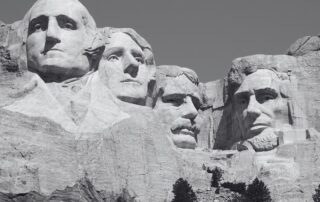
Quick:  how many one term presidents are on Mount Rushmore?

Answer:  none, as Washington, Jefferson, Lincoln, and Theodore Roosevelt all served more than 4 years. By definition of being on Mount Rushmore, they were impactful presidents.

Surprisingly, half of our presidents served one term or less in office. Yes, twenty three of our forty-six presidents had a short time to implement their policies and make a difference.

Among those short-term presidencies, which one was the most impactful?

It’s easy to eliminate William Henry Harrison, since he died only 30 days into his presidency. Five of these men (Tyler, Fillmore, Andrew Johnson, Arthur, and Ford) were vice presidents who ascended to the oval office in an abrupt way due to the death or resignation of the president. They served out the term in unremarkable fashion not to be re-elected.

However, one man became the first ‘dark horse’ candidate to win the White House and did so in part by pledging he would only serve one term and quit.

James K. Polk, Democrat from Tennessee, was little known outside his home state despite having served as the Speaker of the United States House of Representatives. In the presidential election of 1844, the Whigs nominated Henry Clay, a nationally known politician from Kentucky. Polk won the Democratic nomination, beating former president Martin Van Buren and earning the long shot chance to beat Clay.

In the campaign, Polk embraced westward expansion as his primary policy. The annexation of Texas was a hot topic at the time, and Clay came out against it. Polk, better reading public opinion, was fully behind having Texas come into the union. He also endorsed another hot geographical dispute of the day, the Oregon Territory. He agreed we ought to have the northern border as “54/40”, just short of then Russian Alaska. The slogan was “54/40 or Fight”.

Polk also helped his campaign by positioning himself as Young Hickory, a nod to his Tennessee mentor, former president Andrew Jackson. Polk beat Clay 170 to 105 in the Electoral College and took the oath of office on March 4, 1845.

About that time, newspaper editor John O’Sullivan coined the term Manifest Destiny, an all-encompassing concept meant to embrace and encourage westward expansion. The concept assumed the American people’s special virtues and institutions were worthy of replication in the west, the mission to redeem and remake the west in the image of the agrarian east was desirable, and an irresistible destiny was at hand to accomplish coast to coast flourishing of the American way of life.

Newly sworn in President Polk was only too happy to oblige.

Texas was annexed in 1845. The Oregon territorial dispute with Britain was resolved in 1846 at the 49th parallel, bringing all of today’s Washington State and Oregon into the Union.

And Polk wasn’t done yet.

He coveted the vast Mexican held territory of California, Arizona and western New Mexico plus today’s Nevada, Utah, and western Colorado. The question was, how to acquire it?

Mexico and Texas had long disputed the southern border. Mexico believed it was the Nueces River. Texas thought it was the more southern Rio Grande. In 1846, President Polk, as Commander in Chief, purposely positioned armed forces in the disputed territory. When a small fight broke out and some soldiers died, Polk went to Congress for a declaration of war. He won overwhelming support, and the armies, led by Winfield Scott and Zachary Taylor, won the war by finally taking Mexico City.  The Treaty of Guadalupe Hidalgo in 1848 ceded all the Mexican controlled land that Polk wanted for $15 million.

By the end of his one term, James Polk had added immense territories to our country, expanded our coverage to the Pacific Ocean and filled in nearly all the spaces we now know as western states.

Like Jefferson and the Louisiana Purchase agreement with Napoleon in 1803, Polk had a vision of American expansion ‘from sea to shining sea’. That Polk resorted to expansion primarily by force vs. agreement in the case of Mexican possessions remains a much-discussed strategy.

Either way, the one term presidency of James K. Polk goes into the books as the most impactful in our history. Polk, a workaholic, died at age fifty-three, just 90 days after Zachary Taylor succeeded him in 1849.

Interested in learning more about the presidents? Visit the Carolyn & James Millar Presidential Gallery on the upper level of the Booth Western Art Museum. The gallery features original letters and photographs of every U.S. president. Learn more at www.boothmuseum.org.

2024-11-14T14:33:47-05:00Booth Blog|

WE THE PEOPLE: Portraits of Veterans in America

July 6 – November 17, 2024
Member opening July 20, 2024

This exhibition is acclaimed artist Mary Whyte’s unprecedented series of stirring portraits of American veterans.  Featuring veterans of all ages and in all walks of life, one from each of our fifty states, Whyte’s large-scale watercolors have captured the essence of our country’s everyday people with courage, empathy and honor.

© Mary Whyte, Flurries, watercolor, 23.374 x 31”

Sponsored by:

charles schwab
WBHF Logo

Honoring our Veteran Artists

As Veterans Day approaches, we want to take a moment to honor the many talented artists in our collection who have served their country. Thank you to all veterans for your sacrifices and dedication.

David Wright – Served in the U.S. Army from 1964-1965, with a year spent in Vietnam.


© David Wright, Up the South Slope, 1982, casein on board, 26 x 36”

Doug Hye – Enlisted in the US Army with the 198th Light Infantry Brigade in Vietnam

Robert Pummill – Served nine years in the Air Force, specializing in electronics until 1964.


© Robert Pummill, Run on the Cherokee Strip, 1992, oil on canvas, 30 x 48”

Joe Beeler – A veteran of the Korean War, he served in the U.S. Army starting in 1953.

Harry Jackson – Served in the Marine Corps as a combat artist.


© Harry Jackson, The Flag Bearer, 1983, painted bronze, 29.12 x 36 x 10.25”, Booth Western Art Museum permanent collection, Cartersville, GA

Kenneth Riley – A combat artist in the Coast Guard during World War II.

Don Stivers – Served as a Navy corpsman during World War II.

Michael C. Poulsen – Served in the Marine Corps before pursuing his art studies at Arizona State University.

Edward Dwight – Joined the U.S. Air Force in 1953 as a military fighter pilot.


© Ed Dwight, Dirt Farmers, 1980, bronze, 26 x 21 x 12”

Allen Eckman – Served in Vietnam as a Marine.

Donald Spaulding – Served in the U.S. Army from 1944 to 1946.

Denny Haskew – Spent two years in the U.S. Army during the Vietnam War.

Howard Terpning – Served in the Marine Corps during the Vietnam War.


© Howard Terpning, River Crow, 2000, gouache on paper, 54 x 37”

This Veterans Day, let us reflect on their contributions both in service to our nation and in the world of art.

2024-11-04T14:35:41-05:00Booth Blog|

Georgia and the Presidency

While native son Jimmy Carter has nearly universal awareness for his connections to Georgia, you may be surprised to learn that four other 20th-century presidents also have deep ties to our state.

None of these four men were born in Georgia. That distinction belongs solely to Mr. Carter. However, there are familial, medical, career, and recreational ties that mark Georgia as a significant player in presidential history.

Theodore Roosevelt

New Yorker Theodore Roosvelt’s mother, Mittie, grew up in Savannah, Georgia in the mid-1830’s. In 1839 she moved with her family to an area that would become Roswell, Georgia. Daughter of a wealthy planter, her maiden name was Bulloch, and she grew up in a mansion in Roswell called Bulloch Hall.

Mittie married Theodore Roosvelt Sr. in 1853 and moved to New York City where Theodore Jr. was born in 1858.  As president, Theodore Roosevelt visited Bulloch Hall in 1905 and gave a brief speech honoring his combined northern and southern upbringing.  Franklin Roosevelt, Theodore’s fifth cousin, also visited Bulloch Hall several times. Bulloch Hall remains open to the public in Roswell on Bulloch Avenue.

As a matter of local interest, Dunwoody, Georgia is named after Mittie Roosevelt’s brother, James Dunwoody Bulloch.

Woodrow Wilson

Thomas Woodrow Wilson was born in Staunton, Virginia in 1856. His father was a Presbyterian minister and relocated to Augusta, Georgia before Wilson was two years old. Growing up during the Civil War, Wilson was one of two presidents who are considered true ‘citizens of the confederacy’, the other being John Tyler.

In 1882, Woodrow Wilson set up a law practice in Atlanta, but closed it in less than one year due to his boredom with the day-to-day practice of the law. Three years later, he married Ellen Axon, daughter of a Presbyterian minister from Savannah.  He then pursued studies at Johns Hopkins University, achieving a PhD in history and political science, the sole president to have earned a doctoral degree.

Franklin D. Roosevelt

60 miles southwest of Atlanta is Warm Springs, Georgia, famous for its constant 88-degree waters. Franklin Roosevelt first visited Warm Springs in 1924, three years after his diagnosis with polio. He found the warm water eased his symptoms and he enjoyed the area so much he founded a rehabilitation facility for polio victims.

FDR made 16 trips to Warm Springs while President from 1933 to 1945, staying 2-3 weeks each time. He died in his home there in 1945, just prior to victory in Europe during World War II.

Many subsequent politicians made campaign stops in Warm Springs, including John F. Kennedy and Jimmy Carter (who launched his campaign for the presidency there in 1976 following his nominating victory). Bill Clinton visited in 1995 while in office as well. All three wanted to directly connect to FDR’s popular legacy.


Dwight Eisenhower

Dwight D. “Ike” Eisenhower was an avid golfer and joined the famed Augusta National Golf Club in 1948. His immense popularity for having led the allied forces to victory over Hitler meant that he was rumored to be a candidate for president from both major parties. In 1952 he decided to run as a Republican, winning the office in a landslide.

As president Ike couldn’t just ‘stay’ at Augusta while golfing. He needed a safe and proper home away from the White House.  The membership of the club funded the construction of a ‘cabin’ on the 10th tee of the course for Eisenhower. ‘Cabin’ may be too modest a description for the three story, seven bed room home.  He visited Augusta 29 times during his eight years as president.

The Eisenhower cabin was also used by President Ronald Reagan in 1983 while planning the invasion of Grenada.

Jimmy Carter

No story of presidential impact on Georgia would be complete without mentioning native son Jimmy Carter.  His life in Plains, also birthplace of his wife Rosalynn, his governorship of Georgia and his one term as president mark him as a man of high achievement. He later established the Carter Center in Atlanta, also the site of his library and museum, serving as his home base for his fight for peace and humanitarian causes around the world.

Sea Island

There is one more little-known connection of the presidency to Georgia. Beginning in 1928 with Calvin Coolidge, seven presidents have planted live oak trees at Sea Island Resort. These include Eisenhower in 1946, Ford in 1979, Carter in 1981, H. W. Bush in 1991, W. Bush in 2004, and Bill Clinton in 2012. Each tree is marked with a plaque commemorating their presidency and date of planting.

Most of the sites mentioned here are open to the public. If your travels take you nearby one, I recommend you stop for a visit.

Interested in learning more about the presidents? Visit the Carolyn & James Millar Presidential Gallery on the upper level of the Booth Western Art Museum. The gallery features original letters and photographs of every U.S. president. Learn more at www.boothmuseum.org.
2024-10-28T11:52:17-04:00Booth Blog|
Go to Top